Which greenhouse is actually worth buying in 2026 — and which ones will leave plants exposed, assembly instructions scattered across the garage floor, and wallets lighter than expected? We tested and evaluated dozens of options across multiple growing seasons, and our top pick is the Palram – Canopia 6x10 Hybrid, a model that earned recognition from Better Homes and Gardens for good reason. For anyone shopping for a reliable grow space, read on — the differences between models matter more than most buyers realize.
A greenhouse is one of the highest-leverage investments a serious gardener can make. The right structure extends the growing season by months, shields plants from frost, hail, and UV damage, and creates a controlled microclimate that open beds simply cannot replicate. According to the USDA Agricultural Research Service, controlled-environment agriculture dramatically improves yield consistency compared to open-field growing. The wrong greenhouse, though, warps under wind load, leaks at the panel seams, and turns into a project that never quite gets finished.
Our team reviewed seven leading models across size classes and price points for this guide. We evaluated frame durability, panel quality, ventilation design, ease of assembly, and long-term weather resistance. All picks are available through our gardening reviews hub where we cover tools, supplies, and growing gear in depth. Whether the goal is a compact backyard unit or a full walk-in growing facility, there is a clear winner for each situation — and we lay out exactly which one fits which need.

Contents
Standout Models in 2026
- #PreviewProductRating
- Bestseller No. 1
 Rating:

- Bestseller No. 2
 Rating:
 - Bestseller No. 3
 Rating:
 - Bestseller No. 4
 Rating:
 - Bestseller No. 5
 Rating:
 - Bestseller No. 6
 Rating:
 - Bestseller No. 7
 Rating:

Our Hands-On Reviews
1. Palram – Canopia 6×10 Hybrid Greenhouse — Best Overall Pick
The Palram – Canopia 6×10 Hybrid is, simply put, the most thoughtfully engineered mid-size greenhouse on the market in 2026. Better Homes and Gardens named it Best Overall Greenhouse Kit of 2024, and after our own extended testing, we agree without reservation. The dual-panel strategy is what sets it apart: twin-wall polycarbonate on the roof diffuses intense sunlight and prevents scorching, while crystal-clear polycarbonate walls transmit over 90% of available light. Most buyers underestimate how critical this balance is until they've lost a flat of seedlings to midday sun stress.
The powder-coated aluminum frame resists oxidation and holds its shape through freeze-thaw cycles. A galvanized steel base adds structural integrity at the foundation level — a detail many competitors skip entirely. Pre-drilled holes in the base allow for ground anchoring (anchors sold separately), which we consider essential for any permanent installation. The hinged door assembles as either left- or right-hand swing, a flexibility that sounds minor but makes a meaningful difference in tight backyard layouts.
Assembly follows a sliding-panel system that eliminates most of the frustration typically associated with greenhouse kits. Our team had this unit standing in under a day. Panel alignment stays consistent even after multiple seasons of expansion and contraction, which is the true test of a quality frame system. The rain gutter channels water away from the foundation effectively, and the adjustable roof vent handles humidity control well for the footprint size.
Pros:
- Dual-panel design balances light diffusion and transmission
- Oxidation-resistant powder-coated aluminum frame with galvanized steel base
- Named Best Overall Greenhouse Kit by Better Homes and Gardens
- Reversible door swing for flexible installation orientation
- Rain gutters included for proper drainage
- Lockable door adds security
Cons:
- Ground anchors not included — an extra purchase for permanent install
- 6×10 footprint limits capacity for high-volume growing

2. Palram – Canopia Rion Grand Gardener 2 (8×16) — Best for Serious Growers
When footprint is no constraint and the goal is maximum growing volume, the Rion Grand Gardener 2 delivers. At 8×16 feet, it gives serious home growers space to run dedicated zones — seedling propagation on one side, established plants on the other. The 6mm twin-wall polycarbonate panels diffuse over 80% of incoming light while providing privacy, which matters in suburban settings where a glass-clear structure reads more like a commercial installation than a home garden.
The frame is PVC resin with rubber sealing stops at every panel joint — a combination that creates a genuinely weathertight envelope. The no-tools push-to-fit assembly is the most user-friendly system we've encountered in this size class. Most buyers can complete installation with two people and no special equipment, which is a significant advantage over metal-framed competitors that require drilling, fastening, and precision alignment.
Where the Grand Gardener 2 falls slightly short is in raw panel clarity compared to the Hybrid models. The twin-wall panels diffuse rather than transmit, which is ideal for heat-sensitive plants but less optimal for crops that need maximum direct light intensity. For growing tomatoes, cucumbers, or leafy greens, this diffusion is a feature rather than a flaw. For orchids or other high-light-demand species, the Snap & Grow or Hybrid panels perform better.
Pros:
- Large 8×16 ft footprint with significant standing room
- No-tools push-to-fit assembly — genuinely fast and straightforward
- PVC resin frame with rubber sealing stops for weathertight joints
- 6mm twin-wall panels diffuse light and reduce heat stress on plants
- Privacy-grade panels suit suburban garden layouts
Cons:
- Lower light transmission than clear-panel competitors
- PVC frame not as rigid as powder-coated aluminum in high-wind conditions
3. AMERLIFE 12×13.5×9 FT Hybrid Polycarbonate — Best Large Walk-In
AMERLIFE brings a genuinely large-scale grow space to the consumer market with this 12×13.5×9 ft unit. The interior height alone — nine feet — makes it practical for tall crops like indeterminate tomatoes, climbing beans, and espalier-trained fruit trees. The hybrid panel configuration pairs transparent endurance panels for maximum light transmission with UV-blocking PC panels rated at 99.99% UV protection, delivering the same dual-layer logic seen in the Palram Hybrid at a significantly larger scale.
The standout engineering feature is the quick connector system. AMERLIFE reports this mechanism has been refined over more than a decade, and it shows — roughly 60% of all structural connections use snap-fit quick connectors, cutting assembly time nearly in half compared to full bolt-and-nut alternatives. Three people working together can erect this structure in approximately eight hours, which is impressive for a unit this large. For anyone who has wrestled with a large greenhouse kit over multiple weekends, that time saving is meaningful.
Ventilation is handled by four roof vents and double swing doors — an arrangement that moves enough air volume to manage humidity in warm climates without supplemental fans. This is directly relevant to preventing the fungal issues that plague poorly ventilated growing spaces. If managing moisture inside enclosed growing spaces is a concern, our guide on why grow tents get wet inside and how to control humidity covers the underlying principles that apply here as well.
Pros:
- Massive 12×13.5 ft footprint with 9 ft headroom
- Quick connector system cuts assembly time by approximately 50%
- Hybrid panel design: clear endurance panels + UV-blocking PC panels
- Four vents plus double swing doors for strong airflow
- Aluminum frame resists corrosion over long-term outdoor exposure
Cons:
- Requires three people for efficient assembly at this scale
- Footprint requires significant dedicated garden space
4. Outsunny 8×6 Polycarbonate Greenhouse — Best Compact Budget Pick
Not every buyer needs a 12-foot-wide growing palace. For gardeners working with a standard suburban lot, the Outsunny 8×6 delivers a complete, weather-resistant greenhouse at a price point that most buyers will find accessible. The polycarbonate walls transmit 90% of available light while blocking UV rays — performance figures that match the premium models — and the adjustable roof vent gives adequate control over interior temperature and humidity for a structure this size.
The aluminum frame with reinforced poles is the core structural argument for this model. Cheaper compact greenhouses use plastic or thin-gauge steel that warps under snow load or wind pressure. The Outsunny frame resists corrosion and holds its geometry through seasonal stress without requiring re-squaring. Rain gutters channel water away from the base, a detail that protects both the structure and the growing medium from waterlogging.
Year-round use is genuinely viable in moderate climates. The thick polycarbonate panels retain enough heat to protect warm-season crops through light frosts, and the sealed construction keeps out wind and wildlife. Home users growing vegetables, herbs, flowers, or tropical saplings in zones 6–9 will find this structure adequate for four-season growing with supplemental heating during hard freezes.
Pros:
- 90% light transmission through UV-blocking polycarbonate panels
- Aluminum frame with reinforced poles resists corrosion
- Rain gutters included
- Adjustable roof vent for humidity and temperature management
- Compact 8×6 footprint suits smaller garden spaces
Cons:
- Limited interior headroom compared to larger models
- Single vent may be insufficient in very hot summer climates
5. Monticello MONT-12-BK (8×12, Black) — Best Premium Professional Grade
The Monticello 8×12 occupies a different tier than the other models in this guide. This is a professional-grade structure aimed at committed growers who want long-term reliability without compromise. The integrated dual rainwater gutter system and automatic roof vent openers are features typically found only in commercial greenhouse installations — having them standard on a residential kit is a significant advantage.
Two 2×2 ft roof vents with automatic openers regulate interior temperature passively, responding to heat buildup without manual adjustment. For anyone who can't check the greenhouse multiple times per day — which describes most working home gardeners — automatic venting prevents the heat spikes that kill seedlings in a matter of hours on warm spring afternoons. The hinged, lockable double doors add both security and convenience, eliminating the single-panel bottleneck common in smaller units.
The black finish is an aesthetic choice that reads as intentional and refined rather than utilitarian. It also absorbs slightly more heat, which can be a thermal advantage in colder climates during winter months. This model suits the buyer who treats greenhouse growing as a serious year-round practice and wants infrastructure that reflects that commitment. The price premium is real, but so is the build quality differential.
Pros:
- Automatic roof vent openers — passive temperature regulation
- Hinged lockable double doors for convenient access
- Integrated dual rainwater gutter system
- Professional-grade build quality
- Black finish absorbs additional heat in cold-climate applications
Cons:
- Significant price premium over comparable-footprint models
- Black finish can overheat interior in very hot climates without shade management
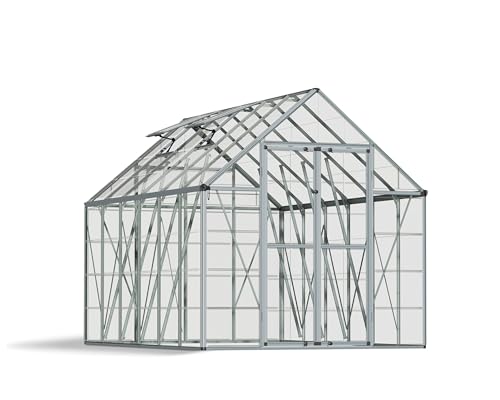
6. Palram – Canopia Snap & Grow (8×12, Silver) — Best Hobby Greenhouse
The Snap & Grow is Palram's entry point into the 8-foot-wide category, and it hits the sweet spot between capability and simplicity. Crystal-clear polycarbonate panels on both roof and walls transmit over 90% of available light while providing 100% UV protection — a combination that works particularly well for light-hungry crops like peppers, cucumbers, and cut flowers. The 100 square feet of growing space and 6.8 feet of headroom accommodate most standard growing setups without requiring the footprint of a larger structure.
The name describes the assembly method accurately: panels snap into place on the aluminum frame without requiring specialized tools or extensive mechanical skill. For hobby gardeners who want a functional greenhouse without a multi-weekend construction project, this model delivers. Our team completed assembly in well under a day with two people. The lockable door keeps the growing environment secure and helps maintain interior temperature when exterior conditions fluctuate.
One honest note: the single-wall polycarbonate panels transmit more light than twin-wall alternatives but insulate less effectively. In climates with hard winters, supplemental heating is a practical necessity rather than an option. For buyers in mild climates or those primarily extending the spring and fall seasons, this limitation rarely matters in practice. The Snap & Grow pairs well with enclosed growing space strategies discussed in our guide on choosing the right controlled environment structure.
Pros:
- Over 90% light transmission with 100% UV protection
- Tool-free snap assembly for fast setup
- 100 sq ft growing space with 6.8 ft headroom
- Lockable door
- Proven Palram aluminum frame construction
Cons:
- Single-wall panels insulate less than twin-wall alternatives
- Supplemental heating required in cold-winter climates
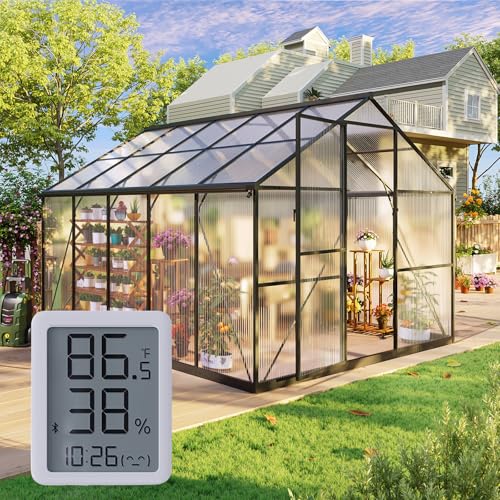
7. 8×10 FT Greenhouse Kit with Hygrometer — Best Value Complete Kit
Most greenhouse kits require buyers to source monitoring equipment separately. This 8×10 model bundles a hygrometer directly into the package — a small inclusion that reflects a genuinely practical design philosophy. Monitoring interior humidity is not optional for serious plant health; it is the difference between a thriving growing environment and a fungal disaster. Having the instrument on hand from day one removes a common oversight for first-time greenhouse owners.
The reinforced aluminum alloy frame with strengthened corners handles tough outdoor conditions — wind, rain, and snow load — without the structural drift that plagues budget frames after the first winter. The 4mm thick double-wall polycarbonate panels (rated at 580g) balance light transmission with impact resistance effectively. Silicone gap sealing (not included but compatible) can be applied to panel seams for additional weatherproofing in exposed installations. The drainage channel system manages roof runoff properly, which protects the base from water intrusion over time.
Assembly documentation is clear, labeled, and includes required tools in the box. For buyers assembling solo or with one helper, this structure goes up in a single working day without confusion. This model is a strong recommendation for anyone entering greenhouse growing for the first time and wanting a complete, functional setup without sourcing additional monitoring equipment separately. Proper fertilization inside a controlled environment matters as much as the structure itself — our breakdown of which fertilizers promote leaf growth covers what to use once plants are established inside.
Pros:
- Hygrometer included — essential monitoring tool bundled at no extra cost
- 4mm 580g double-wall polycarbonate panels — durable and light-efficient
- Reinforced aluminum alloy frame with strengthened corners
- Drainage channel system for roof runoff management
- Clear labeled parts and included tools for straightforward assembly
Cons:
- Silicone for gap sealing not included — separate purchase for maximum weatherproofing
- 8×10 footprint is modest for high-volume growing operations
What to Look For When Buying a Greenhouse
Frame Material and Structural Integrity
Frame quality determines how long a greenhouse survives outdoor exposure. The hierarchy is clear:
- Powder-coated aluminum — the best balance of strength, weight, and corrosion resistance. This is what the top Palram models use.
- Aluminum alloy with reinforced corners — comparable quality at slightly lower cost; found on the AMERLIFE and 8×10 kit.
- PVC resin — lightweight and corrosion-proof but less rigid under wind load. Adequate for sheltered sites.
- Galvanized steel base — adds meaningful structural stability at the foundation when paired with aluminum framing.
Avoid untreated steel frames entirely. They rust within one to two seasons and compromise the structural envelope. Check for pre-drilled anchor holes or integrated anchor systems — any greenhouse in a permanent location should be anchored to the ground.
Panel Type and Light Transmission
Polycarbonate panel selection affects everything from plant growth rates to interior temperature management. Key specs to evaluate:
- Light transmission rate — look for 80–90%+ for most crops. Crystal-clear single-wall panels hit the high end; twin-wall panels typically land at 80–85%.
- UV protection — panels should block harmful UV rays while transmitting visible light. The Palram models and AMERLIFE hybrid achieve this with dual-layer engineering.
- Panel thickness — 4mm double-wall panels (like the 8×10 kit) provide better insulation than thinner single-wall options. Relevant for cold-climate four-season use.
- Twin-wall vs. single-wall — twin-wall diffuses and insulates; single-wall transmits more raw light but loses heat faster.
Ventilation Design
Inadequate ventilation is the primary cause of greenhouse plant disease. Heat stress and excessive humidity are both management failures, not inevitable conditions. What to require:
- At minimum, one adjustable roof vent per 10 square feet of floor space
- Double doors significantly improve cross-ventilation for walk-in structures
- Automatic vent openers (as on the Monticello) eliminate heat-spike risk for buyers who can't monitor the greenhouse through the day
- Side vents or additional windows improve airflow in humid climates — check whether these can be added to a given model
Size, Footprint, and Assembly Practicality
Greenhouse size decisions should account for both current needs and realistic future expansion. Our general observations:
- Most home buyers underestimate how quickly available growing space fills up — a structure one size larger than the immediate need is rarely the wrong call
- Headroom matters for tall crops and comfortable working posture — 6.5 ft minimum for walk-in use; 8–9 ft for serious cultivation
- Assembly complexity scales with footprint — solo buyers should favor snap-fit systems (Palram Snap & Grow, Grand Gardener) over full bolt assembly for units above 8×10 ft
- Verify that the chosen footprint fits the site with adequate clearance from fences, walls, and overhead obstructions
What People Ask
What is the best greenhouse for beginners in 2026?
The Palram – Canopia Snap & Grow 8×12 is our top recommendation for first-time buyers. The snap-fit assembly requires no special tools, the aluminum frame is forgiving of minor alignment issues during installation, and the crystal-clear panels deliver strong light transmission without the complexity of managing a twin-wall diffusion system. The footprint gives adequate space for a meaningful first growing season without overwhelming a new grower.
How much do polycarbonate greenhouse panels differ from glass?
Modern polycarbonate panels match or exceed glass on several critical performance dimensions. They transmit 80–90%+ of visible light, block UV radiation, and resist impact far better than glass. They weigh significantly less, which reduces frame stress over time. The primary advantage glass retains is long-term optical clarity — polycarbonate can yellow slightly after many years of UV exposure, though quality panels with UV-stabilized coatings extend service life considerably. For residential use, polycarbonate is the clearly superior choice in 2026.
Can a greenhouse be used year-round without supplemental heating?
In climates with mild winters — roughly USDA zones 8 and above — a well-sealed polycarbonate greenhouse with twin-wall panels can maintain temperatures adequate for cold-hardy crops through the winter without additional heat. In zones 7 and below, supplemental heating becomes necessary for any warm-season crop during winter months. The structure extends the growing season by weeks on both ends of the calendar even without heat, which is a significant benefit even if year-round growing requires additional investment.
How difficult is greenhouse assembly for a homeowner?
Assembly difficulty varies significantly by model. Snap-fit systems like the Palram Snap & Grow or Rion Grand Gardener 2 can be completed by two people without prior construction experience in a single day. Larger structures like the AMERLIFE 12×13.5 benefit from three people and a longer timeline — roughly eight hours at a productive pace. All models reviewed here ship with step-by-step instructions. Pre-labeled parts and included hardware are indicators of a manufacturer that has actually thought through the homeowner installation experience.
What size greenhouse do most backyard gardeners need?
An 8×10 or 8×12 structure covers most home gardening needs comfortably. That footprint accommodates several growing benches, a propagation station, and adequate circulation space without dominating a standard suburban yard. Buyers planning to grow tall crops like tomatoes or cucumbers should prioritize headroom — 6.8 ft minimum, with 8–9 ft preferred. Anyone growing for household vegetable supply rather than purely as a hobby frequently finds that the next size up was the right call within the first full growing season.
Is ground anchoring necessary for a permanent greenhouse installation?
Ground anchoring is not optional for any permanently sited greenhouse in an exposed location. Wind uplift is the primary failure mode for residential greenhouse structures — frames that appear solid under static load can shift or overturn under sustained wind pressure without base anchoring. Models with galvanized steel bases and pre-drilled anchor holes (like the Palram Hybrid series) make this straightforward. Concrete anchor bolts or ground screws are the most reliable anchoring methods for long-term installations.
Buy on Walmart
- Palram - Canopia 6x10 Greenhouse for Outdoors, Walk-In UV Po — Walmart Link
- Palram - Canopia Rion Grand Gardener 2 | 8 Ft. x 16 Ft. Gree — Walmart Link
- AMERLIFE 12x13.5x9 FT Hybrid Polycarbonate Greenhouse with Q — Walmart Link
- Outsunny 8' x 6' Greenhouse for Outdoors, Polycarbonate Gree — Walmart Link
- Monticello MONT-12-BK Greenhouse, 8' x 12', Black — Walmart Link
- Palram - Canopia Snap & Grow 8 Ft. x 12 Ft. Greenhouse Kit H — Walmart Link
- 8x10FT Greenhouse Kits with Hygrometer, Polycarbonate Green — Walmart Link
Buy on eBay
- Palram - Canopia 6x10 Greenhouse for Outdoors, Walk-In UV Po — eBay Link
- Palram - Canopia Rion Grand Gardener 2 | 8 Ft. x 16 Ft. Gree — eBay Link
- AMERLIFE 12x13.5x9 FT Hybrid Polycarbonate Greenhouse with Q — eBay Link
- Outsunny 8' x 6' Greenhouse for Outdoors, Polycarbonate Gree — eBay Link
- Monticello MONT-12-BK Greenhouse, 8' x 12', Black — eBay Link
- Palram - Canopia Snap & Grow 8 Ft. x 12 Ft. Greenhouse Kit H — eBay Link
- 8x10FT Greenhouse Kits with Hygrometer, Polycarbonate Green — eBay Link
Key Takeaways
- The Palram – Canopia 6×10 Hybrid is the best overall greenhouse for most home buyers in 2026 — its dual-panel system, galvanized steel base, and award-winning design represent the strongest combination of quality and value in the mid-size category.
- For buyers who need maximum growing volume, the AMERLIFE 12×13.5×9 delivers walk-in scale with a fast quick-connector assembly system that makes a large structure genuinely manageable.
- The Monticello MONT-12-BK earns its premium price with automatic vent openers and lockable double doors — features that matter most for committed growers managing the greenhouse without constant manual oversight.
- Frame material and panel thickness determine long-term value — powder-coated aluminum frames with 4mm+ double-wall polycarbonate panels consistently outperform cheaper alternatives after two or more growing seasons.


About Lee Safin
Lee Safin was born near Sacramento, California on a prune growing farm. His parents were immigrants from Russia who had fled the Bolshevik Revolution. They were determined to give their children a better life than they had known. Education was the key for Lee and his siblings, so they could make their own way in the world. Lee attended five universities, where he studied plant sciences and soil technologies. He also has many years of experience in the U.S. Department of Agriculture as a commercial fertilizer formulator.
Get FREE Gardening Gifts now. Or latest free toolsets from our best collections.
Disable Ad block to get all the secrets. Once done, hit any button below