You're standing in the lawn care aisle — or more likely scrolling through Amazon at 11pm — trying to figure out which spreader will actually do the job without leaving you with patchy stripes or a clogged hopper after ten minutes. It's an easy thing to get wrong. The wrong spreader for your yard size wastes your time, your fertiliser, and your money. In 2026, the options are better than ever, and this guide cuts through the noise so you can pick with confidence.
A good lawn spreader is one of the most underrated tools in any gardener's shed. Whether you're overseeding a thin lawn in autumn, applying pre-emergent in spring, or laying down ice melt in winter, the right spreader saves you hours and gives you more even, professional results. We've reviewed seven of the top-rated models — from simple hand-held spreaders for small patches to heavy-duty tow-behind units for acreage — so you can find the one that fits your yard and your workflow. For more on building a healthy outdoor space, check out our gardening reviews for deeper dives into every kind of lawn and garden tool.
According to the U.S. Environmental Protection Agency, over-application of fertiliser is one of the leading causes of nutrient runoff into waterways — another reason accurate spreading matters for your lawn and the environment. The spreaders below help you apply the right amount, in the right place, every time.
Contents
- Editor's Recommendation: Top Picks of 2026
- Full Product Breakdowns
- Scotts Turf Builder EdgeGuard DLX — Best for Mid-Size Lawns
- Scotts Whirl Hand-Powered — Best Hand-Held Spreader
- EarthWay 2600A-PLUS — Best Mid-Range Walk-Behind
- EarthWay 2150 Commercial — Best for Heavy-Duty Use
- Agri-Fab 45-0463 Pull Behind — Best Tow-Behind Broadcast
- Lesco High Wheel — Best Professional-Grade Spreader
- Agri-Fab 45-0288 Drop Spreader — Best Tow-Behind Drop
- Key Features to Consider When Choosing
- FAQs
Editor's Recommendation: Top Picks of 2026
- #PreviewProductRating
- Bestseller No. 1
 Rating:

- Bestseller No. 2
 Rating:
 - Bestseller No. 3
 Rating:
 - Bestseller No. 4
 Rating:
 - Bestseller No. 5
 Rating:
 - Bestseller No. 6
 Rating:
 - Bestseller No. 7
 Rating:

Full Product Breakdowns
1. Scotts Turf Builder EdgeGuard DLX Broadcast Spreader — Best for Mid-Size Lawns
The Scotts Turf Builder EdgeGuard DLX is probably the most recognised walk-behind broadcast spreader on the market, and for most homeowners with a yard between 5,000 and 15,000 square feet, it earns that reputation. The star feature here is the Scotts EdgeGuard Technology, which lets you close off the spread on one side so you can apply right up to garden beds, driveways, and fences without coating everything in fertiliser. That single feature alone prevents a lot of collateral damage to your flower borders.
The control panel sits at the top of the handle and gives you precise rate settings — a small detail that makes a genuine difference when you're following the manufacturer's recommended application rates. The hopper holds enough product to cover a substantial area in a single pass, and the spreader rolls easily on its wide wheels even over slightly uneven ground. It's been designed specifically to work well with Scotts lawn food products, so if you're already in that ecosystem, it's a natural pairing. That said, it works perfectly well with other brands too.
Build quality is solid plastic — it'll handle regular residential use well, but it's not the choice if you're running a landscaping crew. The spread pattern is wide and even when calibrated correctly, and the shut-off mechanism is reliable so you're not leaking product when you stop and start. If you're overseeding this autumn or planning a spring fertiliser schedule, this spreader will make the job feel easy. Just remember to rinse it after every use to prevent corrosion from fertiliser residue.
Pros:
- EdgeGuard Technology blocks spread on one side for precise border application
- Precision rate control panel for consistent, accurate coverage
- Easy to push and manoeuvre on typical residential lawns
- Reliable shut-off mechanism prevents product leakage when stopping
- Widely available and backed by strong customer support
Cons:
- Plastic build won't hold up under heavy commercial use
- Rate settings calibrated primarily for Scotts products — other brands may need trial-and-error adjustment

2. Scotts Whirl Hand-Powered Spreader — Best Hand-Held Spreader
Not every lawn needs a big walk-behind spreader. If you've got a small yard, a courtyard, a narrow side passage, or just a few trouble spots to patch up, the Scotts Whirl Hand-Powered Spreader is one of the most practical tools you can own. It's a crank-operated hand-held spreader that fits comfortably in one hand, holds up to enough product to cover 1,500 square feet, and gets in places a wheeled spreader simply can't reach.
The adjustable arm support is a thoughtful touch that sets this apart from cheaper hand-spreaders. Your wrist and forearm fatigue much less quickly, which matters if you're doing a full circuit of a small-to-medium garden. It works with grass seed, lawn fertilisers, salt, and ice melt, making it genuinely useful year-round — not just a spring-and-autumn tool. The spread pattern is impressively even for a hand-held device when you keep a consistent cranking pace and maintain the same height.
The main limitation is obvious: it's not built for large open lawns. For anything over 2,000–3,000 square feet, you'll be refilling constantly and your arm will know about it. But for targeted patch seeding — say, you're following our guide on hardening off seedlings before transplanting a grass variety — or for spreading de-icer on your front path in winter, this is incredibly convenient and easy to store. It hangs on a nail in the shed without taking up any meaningful space.
Pros:
- Compact and lightweight — ideal for small yards and tight spaces
- Adjustable arm support reduces hand and wrist fatigue
- Multi-use: grass seed, fertiliser, salt, ice melt
- Very easy to clean and store
- Affordable entry point for casual lawn care
Cons:
- Only practical for areas up to about 1,500–2,000 sq ft per fill
- Requires consistent hand speed for an even spread — takes a bit of practice
- Not suitable for larger lawns or commercial applications
3. EarthWay 2600A-PLUS Fertilizer Spreader — Best Mid-Range Walk-Behind
EarthWay has been making spreaders for decades, and the 2600A-PLUS is one of their most popular residential models. It holds 40 pounds of product, which is plenty for a typical suburban lawn in one go, and the rust-proof polypropylene hopper paired with an epoxy powder-coated steel frame gives it noticeably better durability than most plastic-hopper competitors at this price point. This is a spreader built to last more than one season.
The 3-hole drop shut-off system with solid linkage is the key mechanical feature. It delivers a precise distribution pattern — not too wide, not clumped — and the side-spread control lets you feather the edges so you get clean, consistent coverage without harsh lines. The all-terrain pneumatic (air-filled) tires are a genuine upgrade over hard plastic wheels. They roll smoothly over bumps, uneven patches, and even soft ground after rain, making the whole experience less of a workout. For residential and light commercial use alike, this is a very capable machine.
Assembly is straightforward and takes about 20 minutes. The rate adjustment is easy to access while walking. One minor complaint some users note: the gate settings can occasionally drift slightly during use if not locked in firmly, so check your setting after the first few passes. But overall, for the price, this is one of the best-value walk-behind spreaders available in 2026 for lawns up to half an acre.
Pros:
- Rust-proof polypropylene hopper — genuinely durable construction
- 3-hole drop shut-off system delivers precise, even distribution
- All-terrain pneumatic tires handle uneven and soft ground
- 40 lb capacity covers a full residential lawn without constant refilling
- Suitable for residential and light commercial use
Cons:
- Rate gate can drift slightly during use — worth double-checking mid-application
- Spread width is moderate compared to the EarthWay 2150 commercial model
4. EarthWay 2150 Commercial 50 LB Broadcast Fertilizer Spreader — Best for Heavy-Duty Use
When you need more power, more capacity, and more durability than a residential spreader offers, the EarthWay 2150 Commercial steps up. This is a walk-behind broadcast spreader built for serious use — think landscaping professionals, golf course maintenance crews, or homeowners with large lawns who are tired of babying residential equipment. The 13-inch high-flotation pneumatic stud tires are noticeably larger than anything else on this list, and they roll over rough, uneven, or rain-softened ground like it isn't there.
The 50 lb hopper capacity means fewer trips to reload, and EarthWay's signature 3-hole-drop system with side-spread control is present here in its commercial-grade form. The clog-free grate at the bottom of the hopper is a practical feature that often gets overlooked: it separates out any large clumps in your product before they can block the outlet, which means consistent flow and fewer frustrating mid-application stoppages. The grate is also designed to slide in and out when not needed. If you're working with a wide variety of products — grass seed, granular fertiliser, lime (crushed calcium carbonate used to adjust soil pH) — this flexibility matters.
The driving handle gives you better control and more comfortable pushing over longer distances. Assembly requires a bit more effort than the residential models, but it's well-documented. This is a spreader that will outlast several rounds of lighter residential models if it's maintained properly. If your lawn is large and you take turf care seriously, the investment is worth it. If you're also growing ornamental grasses as part of your lawn design, read our ornamental grasses guide for tips on keeping them healthy alongside your main lawn.
Pros:
- Commercial-grade 13-inch pneumatic stud tires handle any terrain
- 50 lb hopper capacity — fewer refill stops on large properties
- Clog-free grate prevents blockages from lumpy or damp material
- Adjustable drop rate directly on the spreader — no stopping to recalibrate
- Built to handle both residential and commercial workloads
Cons:
- Heavier and bulkier — not ideal for small, tight lawns
- Higher price point — overkill for a standard suburban yard
- Takes more time and effort to assemble than residential models
5. Agri-Fab 45-0463 Pull Behind Broadcast Spreader — Best Tow-Behind Broadcast Spreader
If you're mowing with a riding mower or lawn tractor and your property is measured in fractions of an acre rather than square feet, the Agri-Fab 45-0463 is designed exactly for you. A 130 lb hopper capacity means you can cover up to half an acre — roughly 25,000 square feet — in a single load. You hitch it to your tractor and drive; it does the rest. For larger properties, this is the most efficient way to spread fertiliser or seed without spending your entire Saturday doing it.
The universal hitch fits most popular riding mower and tractor brands: Craftsman, Husqvarna, Cub Cadet, John Deere, and more. The 10–12 foot spread width is impressive — it dramatically reduces the number of passes you need to make, which saves time and fuel. The control mechanism lets you start and stop the spread from the tractor seat, which is convenient and prevents wasted product when you're turning or backing up at the end of a row.
Assembly is straightforward and the build quality is reliable for the price point. This is not a commercial spreader — it won't handle the abuse of daily professional use — but for a homeowner with a large lawn who fertilises a few times per year, it's a significant upgrade over pushing a walk-behind spreader over half an acre. The spread pattern is good and relatively even, though like all broadcast spreaders, you'll want to overlap your passes slightly to avoid thin strips. Great value for the scale of coverage it delivers.
Pros:
- 130 lb hopper covers up to half an acre (25,000 sq ft) per load
- Universal hitch fits most major riding mower and tractor brands
- Wide 10–12 ft spread width for fewer passes and faster coverage
- Convenient on/off control from the tractor seat
- Good value for large-lawn homeowners
Cons:
- Requires a riding mower or tractor — no use for push-mower owners
- Not built for heavy commercial use or daily operation
- Broadcast pattern requires overlapping passes to avoid thin strips
6. Lesco High Wheel Fertilizer Spreader with Manual Deflector — Best Professional-Grade Spreader
Lesco is a name that lawn care professionals know well. The Lesco High Wheel Spreader has been a staple on commercial lawn crews for years, and the Model 101186 (which replaces the 091186) carries forward everything that made the original popular. The 80 lb hopper capacity and the high-wheel design give it the combination of range and terrain capability that serious lawn care demands. The large-diameter wheels roll over obstacles that would stop a standard spreader dead in its tracks.
The included manual deflector kit is a practical add-on that lets you control where product goes on one side — particularly useful near garden beds, driveways, and paths where you don't want fertiliser or seed drifting. The enclosed gearbox with a 5:1 gear ratio drives the impeller disc efficiently and consistently, meaning the spread pattern stays reliable even as the hopper empties and the weight changes. That's a refinement you won't find on budget spreaders.
This is a spreader priced and built for professional or serious semi-professional use. If you maintain multiple properties, run a small lawn care business, or simply have a large estate and want equipment that won't need replacing every couple of seasons, the Lesco delivers. The build quality is substantially above the residential models on this list. It's heavier, yes, but it's also the spreader you'll still be using in 2030. For homeowners with average-sized yards, it's probably more spreader than you need — but if you're looking to buy once and be done, it's worth the investment.
Pros:
- Professional-grade build quality — designed to last for years of heavy use
- 80 lb hopper capacity with fewer refills on large jobs
- High-wheel design handles rough terrain easily
- Enclosed 5:1 gearbox provides consistent spread pattern as hopper empties
- Manual deflector kit included for precise edge control
Cons:
- Premium price — overkill for occasional residential use
- Heavier than residential spreaders — more effort to manoeuvre in tight spaces
- Spare parts and calibration charts can be harder to find than mainstream brands
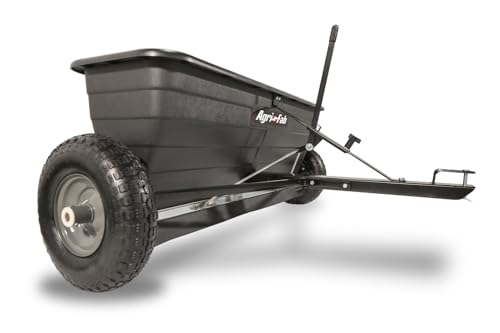
7. Agri-Fab 45-0288 175 lb. Tow-Behind Drop Spreader — Best Tow-Behind Drop Spreader
The Agri-Fab 45-0288 is the heavyweight on this list — literally. A 17-gallon / 175 lb dry hopper capacity is the largest on this roundup, and with coverage of up to 40,000 square feet (roughly one acre per load), this is a serious piece of equipment for serious property owners. Made in the USA, it's a tow-behind drop spreader, which means product falls directly down rather than being broadcast wide — giving you much more precise placement with less drift onto driveways, paths, or planted beds.
The drop spreader design (where material falls straight down between the wheels in a controlled path) is a fundamentally different approach to broadcast spreading. You trade the wide-swath efficiency of a broadcast model for pinpoint accuracy. That makes the Agri-Fab 45-0288 ideal for applying grass seed in a specific overseeding pattern, spreading fertiliser on a striped lawn, or treating narrow areas precisely. It's the right choice when accuracy matters more than speed. If you're managing a property where some areas are planted with specialty grasses — for example, if you've been following advice from our guide to garden fencing ideas to separate lawn sections — the drop spreader keeps things exactly where you want them.
It hitches to riding mowers and tractors, and the control cable lets you open and close the spread gate from the seat. The 175 lb capacity sounds enormous, but it does mean this spreader is physically large and heavy when loaded — make sure you have somewhere practical to store it. For large residential or light farm use, it's an exceptional value given what it can do. Just know that you'll be making more passes per acre than you would with a broadcast model.
Pros:
- 175 lb / 17-gallon hopper covers up to one full acre per load
- Drop spreader design delivers precise, drift-free placement
- Made in the USA — strong build quality and reputation
- Fits most riding mowers and tractors with standard hitch
- Gate control from the tractor seat for clean start/stop
Cons:
- Drop design requires more passes per acre than a broadcast spreader
- Large and heavy — needs ample storage space
- Requires a riding mower or tractor to use
Key Features to Consider When Choosing a Lawn Spreader
With seven models covering very different use cases, the right choice depends almost entirely on your specific situation. Here's what to think through before you buy.
Spreader Type: Broadcast, Drop, or Hand-Held?
This is the most important decision. Each type works differently:
- Broadcast spreaders (rotary) throw product in a wide arc — typically 8–12 feet — making them fast and efficient for large open areas. The trade-off is less precision and some drift near edges.
- Drop spreaders release product straight down in a controlled path directly beneath the hopper. Much more accurate, but you need more passes to cover the same area.
- Hand-held spreaders are manually cranked for small patches, tight spots, and convenience applications like de-icing a front path. Limited capacity but incredibly practical for targeted work.
- Tow-behind spreaders (both broadcast and drop types) attach to a riding mower or tractor. Ideal for properties over a quarter acre where walking the full area is impractical.
Hopper Capacity and Yard Size
Match the hopper size to your lawn. Constantly refilling wastes time and breaks your rhythm:
- Under 5,000 sq ft: A hand-held spreader or a small walk-behind is plenty.
- 5,000–20,000 sq ft: A 40–80 lb walk-behind broadcast or drop spreader handles this comfortably in 1–2 loads.
- 20,000+ sq ft (half an acre or more): Step up to a tow-behind model with 100+ lb capacity. Your back will thank you.
Also consider how dense your typical product is. Grass seed is much lighter by volume than granular fertiliser or ice melt, so a 40 lb hopper might only hold 15–20 lbs of seed by weight.
Wheel Type and Terrain
Don't underestimate the difference wheels make. Hard plastic wheels are fine on flat, smooth lawns but become a real chore on lumpy, sloped, or soft ground. Pneumatic (air-filled) tires absorb bumps, roll over obstacles, and reduce the effort required — especially on larger properties. High-wheel designs give extra clearance and easier pushing on uneven terrain. If your lawn has any meaningful slopes or rough patches, prioritise pneumatic tires in your decision.
Calibration and Spread Control
An accurate spread rate matters for both effectiveness and economy. Too little fertiliser and your lawn won't respond properly. Too much and you risk burning the grass and causing runoff. Look for:
- Clear, easy-to-read rate settings on the control panel
- A reliable gate mechanism that doesn't drift during use
- Edge control features (like the Scotts EdgeGuard) if you have beds or hard surfaces nearby
- A side-spread control or deflector if you need to apply near boundaries without waste
Always calibrate your spreader to a specific product before applying across the whole lawn. Use the product manufacturer's recommended setting as your starting point, then test on a small section first.
FAQs
What's the difference between a broadcast spreader and a drop spreader?
A broadcast (rotary) spreader uses a spinning disc to throw product out in a wide arc — typically 8–12 feet wide — making it fast for large areas. A drop spreader releases product straight down through holes in the bottom of the hopper, covering only the width of the hopper itself. Drop spreaders are slower but much more accurate, making them better for applications near garden beds, hard surfaces, or in striped lawn patterns where you don't want drift.
Can I use the same spreader for grass seed and fertiliser?
Yes — most spreaders on this list are designed to handle both grass seed and granular fertiliser, as well as ice melt and other dry granular products. The key difference is the calibration setting. Grass seed is much lighter and smaller than most fertilisers, so you'll need a different opening size. Always clean the spreader thoroughly between different products, and recalibrate the rate setting when switching materials.
How do I calibrate a lawn spreader correctly?
Start with the rate setting recommended on the product bag for your specific spreader brand. If your brand isn't listed, find the closest match and treat it as a starting point. Do a test pass over a small measured area (say, 10 feet by 10 feet), then weigh the remaining product to calculate how much was applied per square foot. Adjust up or down until your application rate matches the bag's recommendation. This takes 10–15 minutes but saves product and protects your lawn.
How often should I fertilise my lawn?
Most cool-season grasses (like fescue, bluegrass, and ryegrass) benefit from fertilising 3–4 times per year: once in early spring, once in late spring, and once or twice in autumn. Warm-season grasses (like Bermuda or zoysia) are fertilised during the growing season: late spring through summer. Always follow the product label's recommended rates and timing. Over-fertilising can burn your lawn and contributes to nutrient runoff into local waterways.
What's the best spreader for a small yard?
For yards under 3,000–5,000 square feet, a hand-held spreader like the Scotts Whirl is perfectly adequate for targeted applications and is very easy to store. For a small yard where you want to cover the full area evenly, a compact walk-behind broadcast spreader like the Scotts EdgeGuard DLX gives better coverage. The hand-held is better for patches and quick jobs; the walk-behind is better for whole-lawn applications.
How do I clean my spreader after use?
Always clean your spreader after every use — fertiliser and de-icing salt are corrosive and will degrade metal parts and seals over time if left sitting. Empty any remaining product back into the bag, then rinse the hopper and mechanism thoroughly with a garden hose. Tip it upside down to drain fully, then leave it to air dry before storing. A light spray of WD-40 or silicone lubricant on the gate mechanism and moving parts once a season keeps everything running smoothly.
Buy on Walmart
- Scotts Turf Builder EdgeGuard DLX Broadcast Spreader — Walmart Link
- Scotts Whirl Hand-Powered Spreader - for Grass Seed, Lawn Fe — Walmart Link
- EarthWay 2600A-PLUS Fertilizer Spreader, 40lb Hopper Capacit — Walmart Link
- EarthWay 2150 Commercial 50 LB Broadcast Fertilizer Spreader — Walmart Link
- Agri-Fab 45-0463 Pull Behind Broadcast Spreader,130 lb. Hopp — Walmart Link
- Lesco High Wheel Fertilizer Spreader with Manual Deflector - — Walmart Link
- Agri-Fab 45-0288 175 lb. Tow-Behind Lawn & Garden Drop Sprea — Walmart Link
Buy on eBay
- Scotts Turf Builder EdgeGuard DLX Broadcast Spreader — eBay Link
- Scotts Whirl Hand-Powered Spreader - for Grass Seed, Lawn Fe — eBay Link
- EarthWay 2600A-PLUS Fertilizer Spreader, 40lb Hopper Capacit — eBay Link
- EarthWay 2150 Commercial 50 LB Broadcast Fertilizer Spreader — eBay Link
- Agri-Fab 45-0463 Pull Behind Broadcast Spreader,130 lb. Hopp — eBay Link
- Lesco High Wheel Fertilizer Spreader with Manual Deflector - — eBay Link
- Agri-Fab 45-0288 175 lb. Tow-Behind Lawn & Garden Drop Sprea — eBay Link
The best spreader isn't the most expensive one — it's the one that matches your lawn size, your equipment, and the way you actually do yard work.


About Lee Safin
Lee Safin was born near Sacramento, California on a prune growing farm. His parents were immigrants from Russia who had fled the Bolshevik Revolution. They were determined to give their children a better life than they had known. Education was the key for Lee and his siblings, so they could make their own way in the world. Lee attended five universities, where he studied plant sciences and soil technologies. He also has many years of experience in the U.S. Department of Agriculture as a commercial fertilizer formulator.
Get FREE Gardening Gifts now. Or latest free toolsets from our best collections.
Disable Ad block to get all the secrets. Once done, hit any button below