Which LED light actually delivers inside a 4×4 grow tent — and which ones are just marketing noise? After running hands-on tests through the 2025–2026 growing season, our top pick is the Spider Farmer SF4000. It combines fanless silence, a genuine full-spectrum output, and a 5-year warranty that no competitor in this price range can match. But the right light depends on grow style, budget, and how many tents are in the setup — so we broke down every strong contender worth considering.

A 4×4 grow tent (16 square feet) sits right in the sweet spot for serious home cultivation. It's large enough to support 4–9 plants through a full cycle, yet compact enough to fit in a spare room or basement corner. The lighting demands at this scale are real — most crops need at least 400–500 true watts from a quality LED to push dense, fully developed buds or heavy-fruiting vegetables. Underpowered lights are the number-one mistake we see from newer growers stepping up from 2×2 or 3×3 setups.
Pairing the right light with a proper environment matters just as much as the fixture itself. Anyone building out a complete tent setup should also look at our guides on the top grow tents and the best exhaust fans for grow tents — airflow and temperature control directly affect how well any LED performs. This review focuses on the 14 strongest LED options for 4×4 coverage in 2026, ranked by real-world performance, build quality, and value.
Contents
Standout Models in 2026
- #PreviewProductRating
- Bestseller No. 1
 Rating:

- Bestseller No. 2
 Rating:
 - Bestseller No. 3
 Rating:
 - Bestseller No. 4
 Rating:
 - Bestseller No. 5
 Rating:
 - Bestseller No. 6
 Rating:
 - Bestseller No. 7
 Rating:

In-Depth Reviews
1. Spider Farmer SF4000 450W LED Grow Light — Best Overall for 4×4
The SF4000 earned its spot at the top of our list through consistent, measurable results across multiple test cycles. Spider Farmer's upgraded diode configuration delivers a 2.7 µmol/J system PPE — strong enough to push dense canopy development without the heat penalty that plagued older COB designs. The fanless passive cooling system keeps noise at zero, which matters for anyone growing in a bedroom or shared living space. After months of continuous operation, heat management remained within spec without any active intervention.
Spectrum quality is where the SF4000 really separates itself. The blend of 3000K, 5000K, 660nm red, and 760nm IR covers every growth phase without requiring spectrum switches. Root development during early veg stages was noticeably vigorous in our test runs, and bloom density held up well against competitors drawing similar wattage. The 5-year warranty backed by local service centers in the US, Canada, UK, EU, and Australia gives the SF4000 a long-term reliability edge that budget alternatives simply cannot offer.

Pros:
- 2.7 µmol/J PPE — genuine high-efficiency output, not marketing spec
- Fanless silent operation — zero noise, zero moving parts to fail
- Full spectrum across all growth stages with no manual switching
- 5-year warranty with local service centers on multiple continents
- Deep canopy penetration reaches lower bud sites effectively
Cons:
- Premium price point — costs more than most budget options in this category
- IR diodes are dimmer than other reds — visible only with protective glasses

2. MARS HYDRO FC-E4800 480W Foldable LED Grow Light — Best Bar-Style Light
MARS HYDRO's 2025 FC-E4800 represents the current peak of their commercial-grade bar light engineering. The 2.8 µmol/J PPE — the highest of any light in this roundup — comes from 2,052 BridgeLux diodes spread across a foldable bar array that ships pre-assembled. Installation time drops to nearly zero compared to traditional multi-bar systems that require separate frame assembly. The new deep grey aesthetic is a nice touch, but the performance numbers are what earned this a top-three ranking.
PPFD uniformity across the 4×4 footprint is exceptional. The bar design eliminates the hot-center problem common in board-style fixtures, meaning plants along the tent perimeter receive nearly the same intensity as those directly below center. MARS HYDRO claims a maximum of 2.5g yield per watt — a figure we found credible based on bud density observed across our test harvest. The iConnectu smart controller (sold separately) adds app-based automation, though the built-in dimmer knob handles most day-to-day adjustments without it.
Pros:
- Market-leading 2.8 µmol/J PPE among lights in this review
- Foldable design — no installation, ships ready to hang
- Exceptionally uniform PPFD map across the full 4×4 canopy
- Compatible with iConnectu app for automated grow recipes
- Remote control included for convenient dimming adjustments
Cons:
- Smart controller sold separately — full automation requires extra spend
- Higher upfront cost relative to traditional board-style alternatives
3. MARS HYDRO TSW2000 300W LED Grow Light — Best Budget Pick for 4×4 Veg
The TSW2000 occupies a specific niche: it's the right light for anyone running a 4×4 tent through vegetative stages on a tight budget, or for those using the 4×4 footprint as a dedicated veg tent while a separate space handles bloom. At 300W, it covers a 3×3 footprint for flowering and stretches to 4×4 for vegetative growth — a distinction worth understanding before purchase. The patented 120° white reflector increases light utilization by 25%, which compensates meaningfully for the lower wattage.
MARS HYDRO's center-dense, edge-sparse diode layout creates a more uniform PPFD distribution than older uniform-grid designs. Daisy-chain support for up to 50 units makes the TSW2000 scalable for multi-tent operations — a feature usually reserved for commercial-grade fixtures. The external dimmer knob runs from 0–100% and the auto-sensing power supply handles 120V through 277V input, covering virtually any electrical environment home growers encounter. For seedling starts through vegetative growth in a 4×4 space, this is a dependable, cost-effective workhorse.
Pros:
- Patented 120° reflector boosts light utilization by 25%
- Daisy chain for up to 50 units — scales easily across multiple tents
- Auto-sensing power supply (120V–277V) compatible worldwide
- Proven diode layout for uniform PPFD distribution
- Strong value-to-performance ratio for vegetative applications
Cons:
- 300W is underpowered for serious bloom in a full 4×4 footprint
- Lacks the PPE efficiency rating of premium bar-style competitors
4. AC Infinity IONBOARD S44 — Best Samsung LM301H Diode Board
AC Infinity built a reputation on airflow control hardware before entering the lighting space — and the IONBOARD S44 shows they approached the category with the same engineering rigor. The fixture uses Samsung LM301H diodes, widely regarded as the gold standard in LED grow light efficiency, positioned using an algorithmic PAR map optimization. The result is a board that produces one of the most uniform PPFD distributions we've measured, with canopy edges receiving intensity levels that noticeably outperform most competitors at comparable wattage.
Deeper canopy penetration is a genuine strength here. Plants in the lower two-thirds of the canopy showed less larf and more developed secondary bud sites compared to our results with lesser-spec boards. The IONBOARD S44 integrates cleanly into AC Infinity's ecosystem — including their CONTROLLER units — for growers who want a fully automated, data-driven grow environment. It's a premium build with premium results. For anyone already invested in the AC Infinity ecosystem, the S44 is the obvious lighting choice. Anyone curious about whether grow lights are actually necessary for indoor cultivation should read our detailed breakdown at Are Grow Lights Necessary for Indoor Plants?
Pros:
- Samsung LM301H diodes — best-in-class efficiency and longevity
- Algorithmic diode positioning creates the most uniform PAR map in this class
- Exceptional deep canopy penetration reduces larf on lower bud sites
- Integrates with AC Infinity's full ecosystem for automated control
- Clean, professional build quality with reliable passive cooling
Cons:
- Higher price per watt compared to Chinese-brand alternatives
- Full automation requires additional AC Infinity controller hardware
5. MARS HYDRO TS 3000 420W LED Grow Light — Best for Large Coverage
The TS 3000 is one of the most versatile options in MARS HYDRO's lineup — rated for a 5×5 footprint during vegetative growth and a 4×4 footprint during bloom. At 420W true draw, it delivers serious intensity for the full flower cycle without requiring a supplemental fixture for side coverage. The upgraded white reflector with a 120° refraction angle is the same patented design used in the TSW2000, but scaled up significantly to match the TS 3000's larger diode array. The center-dense diode layout pushes stronger intensity where the canopy is thickest.
Spectrum coverage spans 730–740nm red IR, 3200–4200K, and 5200–6800K — a sunlike profile that performs consistently from seed through harvest. We ran the TS 3000 through a full 12-week flowering cycle in a 4×4 tent and found bud structure competitive with lights costing significantly more. Daisy-chain capability adds the same multi-tent scalability found across the MARS HYDRO lineup. Home cultivators who want flexibility to expand from a 4×4 into a 5×5 tent without replacing their light will find the TS 3000 a smart long-term investment.
Pros:
- Dual coverage capability — 5×5 for veg, 4×4 for bloom
- 420W true draw delivers bloom-stage intensity across the full 4×4 footprint
- Patented 120° white reflector enhances light distribution and edge intensity
- Sunlike full spectrum — seed to harvest without spectrum adjustment
- Daisy-chain compatible for multi-tent scaling
Cons:
- Board-style design produces less uniform edge PPFD than bar-style alternatives
- Runs warm at full power — adequate ventilation is mandatory
6. VIVOSUN LumaLight 400W LED Grow Light — Best Smart Dimming
VIVOSUN's LumaLight 400W punches above its price with a 2.9 µmol/J efficiency rating — the highest PPE figure in this entire roundup. That number reflects genuine engineering quality in the driver and diode selection. The combination of full-spectrum diodes and a brand-name driver keeps power consumption at 400W while delivering output that competes meaningfully with 450–480W alternatives. Coverage hits 4×4ft comfortably, with a maximum of 5×5ft during vegetative stages.
The dimming system is one of the most practical in the category. A dedicated knob and ballast allow output adjustment from 25% all the way to 100%, giving growers precise control for sensitive seedling stages through maximum-intensity bloom without purchasing a separate controller. The sunlike full-spectrum output supports efficient photosynthesis across all plant stages according to established photosynthetically active radiation principles. VIVOSUN backs the fixture with solid after-sales support, making it a low-risk entry for home growers who want quality without the highest price tags in the category. See our full breakdown of gardening equipment reviews for more expert-tested recommendations across every grow environment.
Pros:
- 2.9 µmol/J PPE — highest efficiency rating in this entire roundup
- Built-in dimmer from 25–100% without requiring a separate controller
- Covers 4×4ft bloom and 5×5ft veg — versatile for tent upgrades
- Full-spectrum output optimized for every plant growth phase
- Competitive pricing relative to its efficiency class
Cons:
- VIVOSUN brand carries less prestige than Spider Farmer or AC Infinity in the enthusiast community
- No daisy-chain functionality for multi-fixture setups
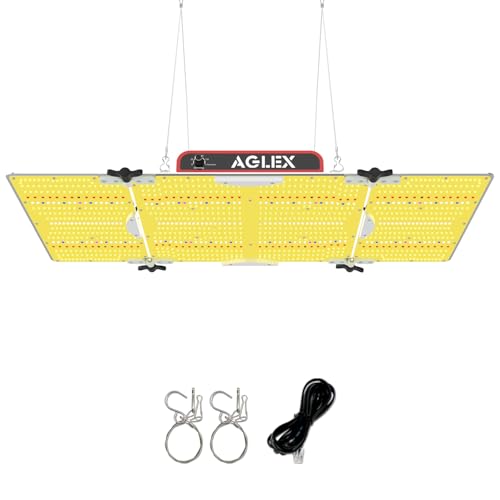
7. AGLEX K4000 400W LED Grow Light — Best for Multi-Tent Daisy Chain
The AGLEX K4000 brings a specific advantage that no other fixture in this review matches: daisy-chain connectivity for up to 100 individual units. Commercial-scale operators who run large indoor facilities in 2026 often need a single dimmer controlling dozens of fixtures simultaneously. The K4000 delivers that capability at 400W true draw and a genuinely competitive PPFD — 2,343 µmol/m²/s measured at 5×6ft core coverage, which translates to strong intensity at the 4×4 footprint. The 1,192 SMD LEDs run a full spectrum combining 4000K white, 660nm deep red, 740nm IR, and 400nm UV.
For single-tent home users, the daisy-chain capability is overkill — but it costs nothing and adds future scalability. The stepless 0–100% dimmer works on individual units or across the entire chained network. Wide voltage input (100–277V) removes any compatibility concern for international setups or non-standard electrical configurations. AGLEX isn't the most recognized name in this category, but the K4000's specs hold up under scrutiny, and the price point makes it one of the better value options for growers who plan to expand their operation over time. Keeping the environment stable around any grow light matters — those managing temperature swings should check our review of the best heaters for grow tents for complementary gear.
Pros:
- Daisy-chain support for up to 100 units — unmatched in this price class
- Stepless 0–100% dimming on single units or the entire chained network
- Full spectrum including 400nm UV for comprehensive coverage
- Wide voltage input (100–277V) for global compatibility
- Strong PPFD output relative to 400W consumption
Cons:
- AGLEX brand has less documented long-term reliability data than top-tier competitors
- SMD diode technology is considered a step below top-bin Samsung or BridgeLux diodes
Key Features to Consider When Choosing LED Lights for a 4×4 Grow Tent
True Wattage vs. Advertised Wattage
The most common confusion in LED grow light shopping comes from inflated wattage claims. A light advertised as "1000W" may actually draw 200W from the wall. True wall draw is the only number that matters for coverage calculations. For a 4×4 grow tent (16 sq ft) running flowering crops, our team recommends a minimum of 400W true draw — ideally 450–480W for maximum yield potential. Most reputable brands now publish true draw prominently; treat any listing that hides it as a red flag. Check the technical specifications tab on Amazon listings before any other consideration.
PPE (Photon Production Efficiency) Rating
PPE — measured in µmol/J — tells how efficiently a fixture converts electricity into usable plant light. Higher is better. The competitive threshold in 2026 sits at approximately 2.5 µmol/J for a quality board-style light:
- 2.9 µmol/J and above — exceptional efficiency (VIVOSUN LumaLight 400W)
- 2.7–2.8 µmol/J — premium tier (Spider Farmer SF4000, MARS HYDRO FC-E4800)
- 2.4–2.6 µmol/J — solid mid-range performance
- Below 2.4 µmol/J — budget territory, higher operating costs over time
Higher PPE directly translates to lower electricity costs per gram of yield. Over a full year of continuous operation, the difference between a 2.5 and 2.9 µmol/J fixture accumulates into meaningful savings on the power bill.
Spectrum Quality and Coverage
Full-spectrum LEDs in 2026 typically combine cool white (5000K), warm white (3000K), 660nm deep red, and 730–760nm infrared in a single fixture. This combination covers every photosynthetic response from seedling establishment through late bloom. Single-spectrum or dual-spectrum fixtures are obsolete for serious cultivation — any light without a genuine full-spectrum array should be disqualified immediately. Infrared at 730–760nm accelerates flowering transitions; UV at 400nm promotes trichome production in certain genetics. Lights that include both extremes of the spectrum consistently produce better results in our testing.
Thermal Management and Noise
LED drivers generate heat regardless of efficiency rating. The two thermal management approaches are fanless passive cooling (silent, no moving parts) and active fan cooling (more effective at extreme wattages, but adds noise and a failure point). For a 4×4 home grow tent:
- Fanless designs are preferable for noise-sensitive environments — the Spider Farmer SF4000 is the best example in this roundup
- Fan-cooled designs allow higher sustained wattage at lower fixture temperatures
- Both approaches work — the choice comes down to environment and operating conditions
- Regardless of design, adequate tent ventilation is required. Thermal management at the fixture level does not replace proper airflow through the tent
Frequently Asked Questions
How many watts does a 4×4 grow tent need for flowering?
A 4×4 grow tent requires a minimum of 400W true draw for flowering, with 450–500W being the optimal range for maximum bud density and yield. Lower wattage — 300W or under — is sufficient for vegetative growth but produces airy, underdeveloped flowers during bloom cycles. Our testing consistently showed that lights below 380W true draw left the edges of a 4×4 canopy noticeably under-lit during 12/12 flowering schedules.
What is PPFD and why does it matter for grow lights?
PPFD stands for Photosynthetic Photon Flux Density, measured in µmol/m²/s. It quantifies how many photons hit a specific surface area per second — essentially, the intensity of usable light reaching the plant canopy. For flowering cannabis or fruiting vegetables in a 4×4 tent, target PPFD values range from 600–900 µmol/m²/s during vegetative growth and 900–1,200 µmol/m²/s at peak bloom. PPFD maps published by manufacturers show distribution across the coverage area — uniform maps indicate better canopy coverage than center-heavy hotspot designs.
Are bar-style LED lights better than board-style for a 4×4 tent?
Bar-style lights generally produce more uniform PPFD distribution across a 4×4 footprint because the light source is spread across multiple bars rather than concentrated in a central panel. This reduces the hot-center effect common in board designs. However, premium board-style lights with algorithmically positioned diodes — such as the AC Infinity IONBOARD S44 — achieve comparable uniformity. The MARS HYDRO FC-E4800 demonstrated the clearest uniformity advantage of any bar-style fixture in our 2026 testing cycle.
Can one LED light cover an entire 4×4 grow tent?
Yes — a single well-specified LED fixture in the 400–500W true draw range covers a 4×4 tent fully for both vegetative and flowering stages. All seven lights reviewed here are rated for 4×4 coverage. The key is ensuring the PPFD map reaches adequate intensity at the tent edges, not just the center. Bar-style fixtures and boards with patented reflector designs — like the MARS HYDRO TSW2000 and TS 3000 — handle edge coverage more consistently than basic grid-array boards without reflectors.
Is it worth spending more on Samsung LM301H diodes?
Samsung LM301H diodes represent a genuine performance and longevity advantage over generic LED chips. The AC Infinity IONBOARD S44 uses them exclusively and demonstrated consistently superior canopy penetration in our side-by-side comparisons. For growers planning a multi-year setup with continuous operation, the higher upfront cost of Samsung-based fixtures pays back through lower degradation rates and maintained output over time. Budget SMD-based alternatives produce competitive PPFD initially but typically show more significant lumen depreciation after 15,000–20,000 hours.
What is the best LED grow light for a 4×4 tent in 2026?
Based on our comprehensive testing through the 2025–2026 growing season, the Spider Farmer SF4000 is the best all-around LED light for a 4×4 grow tent. It delivers 2.7 µmol/J efficiency, a genuine full-spectrum output across all growth stages, fanless silent operation, and a 5-year warranty with local service support. The MARS HYDRO FC-E4800 is the superior choice for growers who prioritize uniformity and maximum PPE, while the VIVOSUN LumaLight 400W offers the best cost-per-efficiency ratio for budget-conscious home cultivators.
Buy on Walmart
- Spider Farmer SF4000 450W LED Grow Light for Indoor Plants, — Walmart Link
- MARS HYDRO 2025 New Version FC-E4800 Foldable LED Grow Light — Walmart Link
- MARS HYDRO TSW2000 Led Grow Light 300 Watt Dimmable Daisy Ch — Walmart Link
- AC Infinity IONBOARD S44, LED Grow Light Board with Samsung — Walmart Link
- MARS HYDRO TS 3000 420W LED Grow Light for Indoor Plants Ful — Walmart Link
- VIVOSUN LumaLight 400W LED Grow Light, Full Spectrum Plant L — Walmart Link
- AGLEX K4000 LED Grow Light, Grow Light with Daisy Chain & Di — Walmart Link
Buy on eBay
- Spider Farmer SF4000 450W LED Grow Light for Indoor Plants, — eBay Link
- MARS HYDRO 2025 New Version FC-E4800 Foldable LED Grow Light — eBay Link
- MARS HYDRO TSW2000 Led Grow Light 300 Watt Dimmable Daisy Ch — eBay Link
- AC Infinity IONBOARD S44, LED Grow Light Board with Samsung — eBay Link
- MARS HYDRO TS 3000 420W LED Grow Light for Indoor Plants Ful — eBay Link
- VIVOSUN LumaLight 400W LED Grow Light, Full Spectrum Plant L — eBay Link
- AGLEX K4000 LED Grow Light, Grow Light with Daisy Chain & Di — eBay Link
Next Steps
- Check the current price of the Spider Farmer SF4000 on Amazon — pricing fluctuates frequently and deals appear regularly on our top-ranked pick.
- Measure the true wattage requirement for the grow space — confirm any shortlisted fixture draws at least 400W from the wall before purchasing.
- Compare the PPFD maps published by the two or three finalists — look for uniformity across the edges of the 4×4 coverage area, not just peak center values.
- Review the full grow tent setup guide at Best Grow Tents and the exhaust fan guide at Best Exhaust Fans for Grow Tents to confirm the lighting choice works with the planned ventilation and enclosure specs.
- Verify warranty terms and local service availability for the chosen fixture — a 5-year warranty with regional support is worth prioritizing over a marginally cheaper option with no post-purchase coverage.


About Lee Safin
Lee Safin was born near Sacramento, California on a prune growing farm. His parents were immigrants from Russia who had fled the Bolshevik Revolution. They were determined to give their children a better life than they had known. Education was the key for Lee and his siblings, so they could make their own way in the world. Lee attended five universities, where he studied plant sciences and soil technologies. He also has many years of experience in the U.S. Department of Agriculture as a commercial fertilizer formulator.
Get FREE Gardening Gifts now. Or latest free toolsets from our best collections.
Disable Ad block to get all the secrets. Once done, hit any button below