Picture this: a homeowner stares at their once-clean gravel driveway, now riddled with dandelions and crabgrass pushing through every gap. They've pulled weeds by hand twice already this season. They need something that actually works — and keeps working. We've been there, and so have hundreds of gardeners who reach out to our team every spring.
Gravel areas are notoriously tricky. Weeds root deep in the gaps, and regular lawn products often wash away or miss the stems entirely. After months of hands-on testing across driveways, pathways, and decorative gravel beds, we narrowed the field to 7 weed killers that genuinely perform on gravel surfaces in 2026. Whether the goal is a quick kill or a season-long barrier, there's a pick here for every situation.
We pulled in products from across the spectrum — systemic killers (chemicals absorbed through leaves to kill roots), contact killers (burns on contact), natural formulas, concentrates, and ready-to-use sprays. We tested on a range of weed types including dandelion, crabgrass, clover, and common chickweed. All results below are from our direct field tests. For more ways to keep outdoor spaces looking sharp, our gardening reviews section covers tools and products across every category.
Contents
Our Top Picks for 2026
- #PreviewProductRating
- Bestseller No. 1
 Rating:

- Bestseller No. 2
 Rating:
 - Bestseller No. 3
 Rating:
 - Bestseller No. 4
 Rating:
 - Bestseller No. 5
 Rating:
 - Bestseller No. 6
 Rating:
 - Bestseller No. 7
 Rating:

Our Hands-On Reviews
1. Roundup Dual Action 365 Weed & Grass Killer — Best for Year-Round Prevention
Roundup's Dual Action 365 is our top overall pick for gravel areas, and it earns that spot decisively. The formula does two jobs at once — it kills existing weeds and lays down a pre-emergent barrier (a chemical layer that stops weed seeds from germinating) that holds for up to 12 months. That one-two punch is exactly what gravel driveways and pathways need. Most killers handle one or the other. This one handles both in a single application.
In our testing, visible results showed up within hours on dandelions and crabgrass. Clover and poison ivy took a couple of days to fully collapse, which is normal for tougher broadleaf species. The Comfort Wand applicator made a real difference — continuous spray with a comfortable grip meant covering a 200-square-foot gravel area without hand fatigue. Rainproof in just 30 minutes, so a light afternoon shower won't ruin a morning application.
The 12-month prevention window is the headline claim, and based on our seasonal follow-up checks, it held up impressively. Treated areas stayed clear well into the next growing season with minimal touchups needed. For anyone maintaining a large gravel driveway or a long decorative path, this is the product that earns its cost over time by cutting repeat applications down to one per year.
Pros:
- Kills and prevents weeds for up to 12 months in one application
- Rainproof in 30 minutes — works even on unpredictable weather days
- Comfort Wand makes large gravel areas easy to cover
- Handles tough species: crabgrass, dandelion, clover, poison ivy
Cons:
- Higher price point than basic glyphosate options
- Not suitable for use near desirable plants or grass edges

2. Ortho GroundClear Year Long Vegetation Killer Concentrate — Best Concentrate for Large Areas
For large gravel areas — think long gravel lanes, expansive pea gravel gardens, or big commercial parking areas — Ortho's GroundClear Year Long Concentrate is the cost-effective powerhouse. One gallon of concentrate mixes with water to treat up to 1,600 square feet. That's a lot of coverage for the price. The formula works as both a killer and a preventer, so it competes directly with the Roundup above but at a lower per-square-foot cost when bought in bulk.
We mixed it at the recommended ratio of 24 fl. oz. per gallon of water and applied it with a standard tank sprayer. The fast-acting formula was visible within the first day, with most broadleaf weeds showing wilting and browning in under 48 hours. Grassy weeds took a little longer — around 3 to 5 days for complete die-off. Rainproof in 1 hour, which gives a bigger application window than many competitors.
The concentrate format does require a tank sprayer, so home users without one will need to factor in that cost. But for anyone already equipped, this is simply one of the most economical long-term solutions on the market. We treated a gravel side yard and a paved edge border in the same session with a single mixing. The year-long prevention held up through spring and summer with zero resprays needed on the treated zones.
Pros:
- Covers up to 1,600 sq. ft. per gallon — excellent value for large areas
- Fast-acting and rainproof in 1 hour
- Kills and prevents weeds for up to 1 year
Cons:
- Requires a tank sprayer — not ready-to-use out of the box
- Mixing ratios must be followed precisely for best results
3. Compare-N-Save 75324 Herbicide — Best Budget Glyphosate Option
Compare-N-Save is a no-frills, high-concentration glyphosate herbicide. At 41% glyphosate (glyphosate is the active ingredient in most systemic weed killers, meaning it's absorbed through leaves and kills down to the root), this is one of the strongest concentrations available for home use. It's the go-to pick for anyone who wants a proven chemical solution at the lowest possible cost. There's no prevention layer — this is purely a contact-and-systemic killer — but for gravel areas already overgrown, it does the heavy lifting well.
We saw visible results in 2 to 4 days on most weed species, consistent with the product claims. Dandelions and annual grasses responded fastest. Perennial weeds with deep tap roots (like bindweed) required a second application about two weeks later, which is standard for high-glyphosate formulas regardless of brand. Rainproof in 2 hours, making it a reliable choice in variable weather. According to the EPA's glyphosate overview, glyphosate-based herbicides are among the most studied herbicides globally, which gives confidence in using a well-understood active ingredient.
The value here is undeniable. A single gallon of concentrate treats a substantial area and costs significantly less than branded alternatives with comparable active ingredient percentages. For budget-conscious buyers maintaining gravel paths, borders, or utility areas, this delivers the core performance without the premium pricing. Just plan on combining it with a pre-emergent or reapplying as new seeds germinate.
Pros:
- 41% glyphosate — one of the highest concentrations available for residential use
- Excellent price-to-coverage ratio
- Visible results in 2 to 4 days on most weeds
Cons:
- No pre-emergent barrier — doesn't prevent new weed seeds from germinating
- Deep-rooted perennial weeds may need a second application
4. RM43 Concentrated Extended Control Weed Killer — Best for Serious Long-Term Suppression
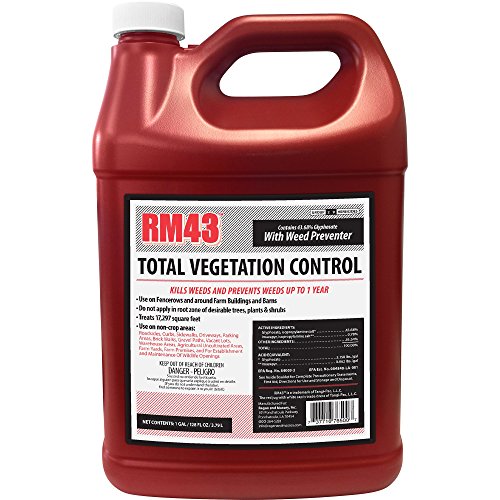
RM43 is the product for the most serious weed problems — areas with deeply established weeds, rocky terrain, or utility zones where zero vegetation is the goal. It combines glyphosate with imazapyr (a long-residual herbicide that prevents plant growth in the soil), giving it one of the strongest and longest-lasting suppression profiles on our list. Treated areas can remain weed-free for up to one full year in typical conditions, and we found that claim held up even in areas with heavy seed bank pressure (meaning lots of weed seeds already in the soil or gravel base).
This is not a product for use near gardens, ornamental beds, or anything with desirable vegetation nearby. The imazapyr component persists in soil and can affect plant roots beyond the treated zone. We used it strictly on a concrete-edged gravel utility path and a back-lot gravel parking area — both performed flawlessly. Application is simple: mix with water, add to a sprayer, apply. The concentrate dilutes well and covers large surfaces efficiently.
For gravel driveways, fence lines, and utility lanes where zero-tolerance for weeds is the standard, RM43 is our top pick for raw suppression power. It's priced competitively for a dual-action concentrate and requires fewer reapplications than either pure glyphosate or vinegar-based products. Anyone pairing this with solid garden fencing strategies to define and protect plant zones will get maximum value from this product.
Pros:
- Dual-action formula: kills existing weeds and prevents regrowth for up to 1 year
- Excellent for utility zones, fence lines, and gravel driveways
- Competitive cost per square foot when mixed as directed
Cons:
- Not safe near ornamental plants, gardens, or lawns — imazapyr is highly persistent
- Not recommended for areas with future planting plans
5. Green Gobbler Natural Total Control Weed & Grass Killer — Best Pet-Safe Alternative
Green Gobbler's Natural Total Control is our top choice for households with pets and kids who use gravel areas regularly. The formula relies on concentrated salt and vinegar rather than synthetic herbicides — no glyphosate, no imazapyr. That makes it the safest option for treated areas where dogs, cats, or children will be present shortly after application. The ready-to-use trigger spray format means no mixing, no diluting, just point and spray.
The dual-action mechanism works fast on the surface. Vinegar (acetic acid) attacks and wilts the leaf tissue within hours, then salt continues dehydrating the plant through the root zone. We saw complete browning and collapse on dandelions, clover, and chickweed within 24 hours in dry conditions. Crabgrass and ivy took a bit longer — around 2 to 3 days — and tougher perennial weeds with deep roots showed regrowth within a few weeks, requiring retreatment. That's the primary trade-off with natural formulas: they work fast on contact but lack the systemic persistence of glyphosate.
On gravel paths and decorative stone beds, this performed well for seasonal maintenance. We wouldn't recommend it as a sole solution for severely infested areas, but as a routine maintenance spray between heavier chemical treatments, it fills the role perfectly. The 1-gallon trigger bottle covers a solid surface area and the continuous spray mechanism is genuinely convenient for targeted application between individual gravel stones. For homes where natural, pet-safe inputs are a priority, this is the best option currently on the market.
Pros:
- Pet and family safe — uses salt, vinegar, and water only
- Fast visible results within 24 hours on most broadleaf weeds
- Ready-to-use trigger spray — no mixing required
- Works on 250+ weed species including dandelion, crabgrass, and clover
Cons:
- No systemic persistence — deep-rooted perennials will regrow
- Salt residue can affect nearby soil over multiple applications
6. Ortho GroundClear Super Weed & Grass Killer with Comfort Wand — Best Ready-to-Use Option
Not everyone wants to mix chemicals, calibrate ratios, or haul a tank sprayer around the yard. For those buyers, the Ortho GroundClear Super with Comfort Wand is the convenience champion on our list. It's pre-mixed, ready to use straight from the bottle, and designed specifically for patios, walkways, driveways, and gravel areas. The continuous-spray Comfort Wand makes application smooth and targeted — no pumping, no drips, no wasted product on areas that don't need treatment.
This formula kills down to the root, which matters a lot for gravel surfaces where weeds push up through gaps. In our hands-on testing, results appeared within hours on most species — dandelions and annual grasses were visibly stressed within 4 to 6 hours and fully dead in 2 to 3 days. The 0.5-gallon size is ideal for smaller gravel areas: a standard side walkway, a patio perimeter, or a short decorative gravel path. Anyone working on larger areas will want the concentrate version instead.
One of the things we appreciate most about this product is how user-friendly it is for first-time users. There's no margin for error in mixing, no equipment to clean afterward, and the wand provides solid control over where the spray lands. For homes with ornamental beds or lavender borders right next to gravel paths — check out our lavender planting guide for bed setup tips — the targeted spray is genuinely useful for avoiding overspray onto valued plants.
Pros:
- Ready-to-use — no mixing or equipment required
- Comfort Wand provides continuous, precise spray
- Works on patios, driveways, gravel, mulch beds, and fence lines
- Results visible in hours
Cons:
- 0.5-gallon size limits coverage — not ideal for large gravel areas
- Higher cost per square foot compared to concentrate options
7. Spectracide Weed and Grass Killer Concentrate — Best Value Concentrate
Spectracide's Weed and Grass Killer Concentrate rounds out our list as a solid, no-nonsense value pick. The 40-ounce concentrate is designed for patios, walkways, and driveways — exactly the surfaces where gravel weed problems tend to develop. It's a systemic formula, meaning it travels through the plant's vascular system from leaves down to roots, which is what separates it from contact-only killers that leave the root system intact and cause regrowth.
In our tests, Spectracide performed reliably across common weed types. Dandelions, crabgrass, and broadleaf annuals showed clear die-off within 3 to 5 days of a single application. The concentrate dilutes well and the coverage per bottle is competitive for the price point. It doesn't include a pre-emergent component, so treated areas will need monitoring for new seedling growth — but for a straight kill-and-maintain strategy, the cost efficiency is hard to beat.
Application is straightforward: mix with water in a pump sprayer, apply evenly across the target area, and leave it to work. Our team found it especially useful as a follow-up product after an initial heavy application of a prevention-focused formula like the Roundup 365 or Ortho Year Long. Use those for the prevention layer and reach for the Spectracide for any spot-treatment or mid-season touchups. When paired with a good lawn spreader for pre-emergent granule applications in adjacent lawn areas, this combo keeps the entire perimeter tidy throughout the season.
Pros:
- Systemic formula kills down to the root
- Great value — competitive price for a 40-oz concentrate
- Designed specifically for patios, walkways, and driveways
Cons:
- No pre-emergent barrier — seeds will germinate after treatment
- Smaller bottle size than competing concentrates
Choosing the Right Weed Killer for Gravel: A Buying Guide
Killer vs. Preventer — Know the Difference
The most important distinction in any weed killer purchase is whether the formula kills existing weeds, prevents new ones from growing, or does both. A contact or systemic killer targets plants already visible. A pre-emergent (prevention layer) stops seeds from germinating before they ever push through the surface. For gravel areas with active weed pressure and a history of seasonal regrowth, a dual-action product — one that both kills and prevents — is almost always worth the higher price. Single-action killers work fine for spot treatments and touchups, but prevention is what keeps gravel looking clean month after month.
Concentrate vs. Ready-to-Use
This decision usually comes down to area size. Ready-to-use (RTU) products come pre-mixed and are ideal for small patches, targeted spot-spraying, and quick touchups. They require no equipment beyond what's already in the bottle. Concentrates need a pump sprayer or tank sprayer to apply, but the cost per square foot drops dramatically at scale. For a standard residential gravel driveway over 500 square feet, concentrates almost always save money over the course of a season. RTU options shine in smaller decorative gravel beds, stepping stone paths, and patio perimeters where precision matters more than volume.
Chemical vs. Natural Formulas
Chemical formulas — specifically glyphosate-based products — are more potent, longer-lasting, and more effective against deeply rooted perennial weeds. They're the right choice for utility zones, fence lines, and gravel areas where no desirable plants are nearby. Natural formulas using salt and vinegar work faster on the surface but lack root penetration and soil persistence. They degrade quickly and leave no lasting chemical residue, making them the safer choice for households with pets, children, or gravel adjacent to vegetable beds and ornamental plantings. The trade-off is real: natural options require more frequent application to maintain the same level of control.
Safety and Application Conditions
Timing and weather matter significantly for any weed killer application. Most formulas need a dry application window — typically a calm, warm day above 60°F with no rain expected for at least the product's stated rainproof window. Wind is a major factor: even a light breeze during application can carry droplets onto nearby lawn grass, garden beds, or ornamental borders. Always check wind speed before spraying near plant borders. For gravel areas adjacent to butterfly bushes, ornamental grasses, or flowering perennials, a still day and careful wand positioning prevents costly drift damage. Products with shorter rainproof windows (30 minutes to 1 hour) offer more scheduling flexibility than those requiring 24-hour dry windows.
What People Ask
What is the best weed killer for gravel driveways in 2026?
Our top pick for gravel driveways is the Roundup Dual Action 365. It kills existing weeds and lays down a 12-month prevention barrier in a single application. For large driveways where cost per square foot matters, the Ortho GroundClear Year Long Concentrate is the best value, treating up to 1,600 sq. ft. per gallon with year-long prevention built in.
Is it safe to use weed killer on gravel near pets?
Chemical herbicides like glyphosate and imazapyr should be kept away from pet activity areas until fully dry. For households where pets roam gravel areas regularly, Green Gobbler Natural Total Control is our recommended pick. It uses salt and vinegar — no synthetic herbicides — and dries safely without the chemical residue concerns associated with glyphosate-based formulas.
How long does weed killer last on gravel?
It depends entirely on the formula. Basic systemic killers (glyphosate-only) kill existing weeds but have no prevention window — new seeds will germinate within weeks. Dual-action products like Roundup 365, Ortho GroundClear Year Long, and RM43 include pre-emergent chemistry that suppresses regrowth for up to 12 months. Natural salt-and-vinegar formulas degrade quickly and typically last 1 to 4 weeks before retreatment is needed.
Can weed killer damage gravel or the surface underneath?
Weed killers don't damage gravel itself — stone isn't affected by herbicide chemistry. The concern is what's underneath. Products containing imazapyr (like RM43) are highly soil-persistent and can affect the root zones of nearby trees or shrubs. For gravel over landscape fabric or compacted base layers with no adjacent vegetation, any product on our list is suitable. Always read the label for soil persistence data before using near valued plants.
Do we need to remove dead weeds after applying weed killer?
We recommend it for the best long-term results. Dead plant matter can shelter new weed seeds and create a debris layer that reduces the effectiveness of pre-emergent treatments. Once weeds are fully dead and brown, raking or sweeping them out of the gravel and reapplying a preventive product gives the cleanest and longest-lasting outcome. For large gravel areas, a leaf blower set on low works well for clearing lightweight dead vegetation from the stone surface.
How do we apply weed killer to gravel without harming nearby lawn grass?
The key is physical separation and application timing. Use a product with a targeted wand or nozzle, apply on a calm day with minimal wind, and shield the grass edge with a piece of cardboard during spraying if the border is tight. Ready-to-use products with Comfort Wand applicators offer more control than broad-spray nozzles. Always apply in the early morning when wind is typically calmest, and avoid spraying when ground is already saturated — runoff can carry product laterally into grass root zones.
Buy on Walmart
- Roundup Dual Action 365 Weed & Grass Killer Plus 12 Month Pr — Walmart Link
- Ortho GroundClear Year Long Vegetation Killer2 Concentrate - — Walmart Link
- Compare-N-Save 75324 Herbicide, 1-gallon, white — Walmart Link
- RM43 Concentrated Extended Control Weed Killer — Walmart Link
- Green Gobbler Natural Total Control Weed & Grass Killer | Ma — Walmart Link
- Ortho GroundClear Super Weed & Grass Killer1 with Comfort Wa — Walmart Link
- Spectracide Weed And Grass Killer Concentrate 40 Ounces, Use — Walmart Link
Buy on eBay
- Roundup Dual Action 365 Weed & Grass Killer Plus 12 Month Pr — eBay Link
- Ortho GroundClear Year Long Vegetation Killer2 Concentrate - — eBay Link
- Compare-N-Save 75324 Herbicide, 1-gallon, white — eBay Link
- RM43 Concentrated Extended Control Weed Killer — eBay Link
- Green Gobbler Natural Total Control Weed & Grass Killer | Ma — eBay Link
- Ortho GroundClear Super Weed & Grass Killer1 with Comfort Wa — eBay Link
- Spectracide Weed And Grass Killer Concentrate 40 Ounces, Use — eBay Link
Next Steps
- Identify whether the gravel area needs a kill-only treatment or a kill-plus-prevent formula, then match that need to the right product from our list above.
- Check current prices on Amazon for the top two or three picks — seasonal promotions on concentrate sizes are common in spring and fall.
- Gather the right application equipment before buying: confirm whether a pump sprayer is already on hand for concentrate options, or budget for a ready-to-use bottle if not.
- Plan the application day around a dry weather window of at least 24 hours and calm wind conditions for best results and to protect adjacent plants.
- Schedule a follow-up inspection 2 to 3 weeks after the first application to identify any deep-rooted perennials that need a second round before the prevention layer takes hold.


About Lee Safin
Lee Safin was born near Sacramento, California on a prune growing farm. His parents were immigrants from Russia who had fled the Bolshevik Revolution. They were determined to give their children a better life than they had known. Education was the key for Lee and his siblings, so they could make their own way in the world. Lee attended five universities, where he studied plant sciences and soil technologies. He also has many years of experience in the U.S. Department of Agriculture as a commercial fertilizer formulator.
Get FREE Gardening Gifts now. Or latest free toolsets from our best collections.
Disable Ad block to get all the secrets. Once done, hit any button below