American homeowners and gardeners spend an estimated $1.5 billion on herbicides every year — and that figure keeps climbing as weed pressure intensifies across lawns, driveways, and garden beds. Whether you're battling stubborn dandelions in a manicured lawn or trying to reclaim a gravel path overrun with crabgrass, choosing the wrong product can mean wasting time, money, and patience. In 2026, the market is more crowded than ever, which makes side-by-side comparisons critical before you buy.
Not all weed killers work the same way. Selective herbicides target specific plants without harming surrounding grass, while non-selective formulas kill nearly everything they touch. Some products act within hours; others work slowly through the root system for a more complete kill. And then there's the chemical vs. natural debate — glyphosate-based formulas remain the most effective option for most weeds, but organic alternatives made with vinegar and salt are gaining real ground for pet-friendly households. For more targeted options, our guide to the 7 best weed killers for gravel breaks down what works on hard surfaces specifically.
This guide covers seven of the best weed killers available on Amazon right now, tested and reviewed across different yard conditions. You'll find picks for bare ground, lawn-safe applications, brush and vine removal, and long-term prevention. If you're also thinking about general gardening tips to pair with your weed control strategy, that resource has plenty of practical advice on keeping your outdoor space healthy year-round. Let's get into the reviews.

Contents
Our Top Picks for 2026
- #PreviewProductRating
- Bestseller No. 1
 Rating:

- Bestseller No. 2
 Rating:
 - Bestseller No. 3
 Rating:
 - Bestseller No. 4
 Rating:
 - Bestseller No. 5
 Rating:
 - Bestseller No. 6
 Rating:
 - Bestseller No. 7
 Rating:

Our Hands-On Reviews
1. Roundup Weed and Grass Killer₄ with Pump 'N Go 2 Sprayer — Best Ready-to-Use Formula
If you want something you can grab and spray without mixing or measuring, the Roundup Weed and Grass Killer₄ with Pump 'N Go Sprayer is one of the most convenient ready-to-use options on the market. The 1.33-gallon jug comes with a built-in pump sprayer that pressurizes in a few pumps and lets you cover a large area without constantly stopping to re-pressurize. That's a real advantage when you're tackling a long fence line or a heavily weeded garden bed.
The formula itself is proven. It kills weeds and grasses down to the root — including dandelion, crabgrass, poison ivy, clover, and spotted spurge — and it becomes rainproof in as little as 30 minutes. Visible results typically show within a few hours, which is satisfying when you want confirmation the product is working. Depending on what you're planting next, you can replant as early as 1 day or up to 30 days after application, giving you flexibility in your garden planning. According to the EPA's glyphosate registration review, glyphosate-based herbicides remain among the most widely studied active ingredients in residential use.
The Pump 'N Go mechanism is genuinely useful — no separate sprayer purchase needed. However, the sprayer wand is fixed, which means you can't adjust the spray pattern as precisely as you might with a dedicated pump sprayer. That's a minor trade-off for most homeowners who just want an easy grab-and-go solution for occasional weed control around flower beds, trees, and hardscape edges.
Pros:
- Integrated pressurized sprayer — no separate equipment needed
- Rainproof in 30 minutes, results visible within hours
- Kills 100+ weed types including poison ivy and crabgrass
- Large 1.33-gallon capacity covers significant ground in one session
- Flexible replanting window (1–30 days depending on plant)
Cons:
- More expensive per ounce than concentrate formulas
- Fixed wand limits spray pattern precision on tight areas
- Not selective — will kill grass and desirable plants if you're not careful

2. Compare-N-Save 75324 Herbicide — Best Budget Glyphosate Concentrate
When you need to cover a large area without spending a fortune, the Compare-N-Save 75324 Herbicide is hard to beat. It contains 41% glyphosate — the same concentration as many premium brands — at a fraction of the price. One gallon of concentrate makes a significant volume of ready-to-spray solution, which makes this the go-to pick for homeowners with large properties, long driveways, or multiple garden zones to treat.
Performance is solid and consistent. Rainproofing kicks in after 2 hours, and you'll typically see visible results within 2 to 4 days. It won't act as fast as some ready-to-use products, but at this price point, waiting an extra day or two is a reasonable trade-off. You do need your own pump sprayer, which adds a small upfront cost — but if you're doing any volume of weed control, a good sprayer is an investment you'll use repeatedly.
This is a non-selective formula, meaning it kills grasses and broadleaf weeds alike. Use it on driveways, fence lines, walkways, and any area where you don't mind eliminating all vegetation. Keep it away from lawn edges unless you're working with a very controlled application. If you're also looking to maintain healthy grass between treatments, pairing this with a quality lawn spreader for overseeding after application makes a lot of sense.
Pros:
- 41% glyphosate — same active ingredient as premium brands
- Outstanding value for large coverage areas
- Rainproof in 2 hours
- Proven results within 2–4 days
Cons:
- Requires a separate pump sprayer
- Slower visible results than some competitors
- No included applicator for precise spot treatments
3. Green Gobbler Natural Total Control Weed & Grass Killer — Best Pet-Safe Natural Option
If you have kids running around the yard or pets that treat your garden as their personal playground, Green Gobbler's Natural Total Control is worth serious consideration. Unlike glyphosate-based formulas, this product is made with concentrated salt and vinegar — familiar household ingredients that are tough on weeds but won't send your family indoors for hours after application. The 1-gallon trigger-spray bottle is ready to use right out of the box, which is convenient.
The chemistry here is a two-pronged approach: vinegar acts quickly to wilt and desiccate leaves on contact, while salt follows through to dehydrate the plant at the root level. The company claims it kills over 250 types of weeds and grasses, including broadleaf, crabgrass, dandelion, clover, ivy, and chickweed. In practice, it works best on young, actively growing weeds. Mature, deep-rooted perennial weeds may require multiple applications before they're fully eliminated — that's the honest trade-off you make with natural formulas versus chemical ones.
This is ideal for driveways, sidewalks, concrete, pavers, mulch beds, and flower bed edges where you want effective weed control without reaching for synthetic chemicals. It's not the best choice for large bare-ground areas or serious invasive brush — for that, you'll want one of the glyphosate-based options on this list. But for targeted, frequent use around areas where people and pets spend time, it's a genuinely effective and reassuring choice in 2026.
Pros:
- Pet-safe and people-safe formula using salt, vinegar, and water
- Ready-to-use with integrated trigger sprayer
- Kills 250+ weed and grass types
- Dual-action: fast wilt from vinegar + sustained root kill from salt
- Safe to use on driveways, pavers, sidewalks, and mulch beds
Cons:
- May require repeat applications on established perennial weeds
- Less effective than glyphosate on deep-rooted or woody weeds
- Salt can affect soil chemistry over repeated heavy applications
4. BioAdvanced Brush Killer Plus Concentrate — Best for Brush, Vines & Poison Ivy
Standard weed killers often struggle with tough woody plants, thick vines, and invasive brush. The BioAdvanced Brush Killer Plus is specifically engineered for this challenge. Its concentrated formula is built to penetrate and kill over 75 types of brush, woody weeds, and vines — including poison ivy, poison oak, and blackberry. If you've ever tried clearing an overgrown fence line or a patch of encroaching invasive plants, you know how satisfying a product like this can be when it actually works.
What sets this apart is its systemic action. The herbicide absorbs through the leaves and shoots, then moves through the plant's vascular system to reach and kill the roots. This "slow kill means full kill" approach is deliberate — it takes longer to show visible results than contact herbicides, but the root destruction means regrowth is significantly reduced. You're not just topping the plant off; you're working from the inside out to stop it completely.
The 32 oz concentrate mixes with water for application. You'll need a pump sprayer, and you'll want to apply on a calm, dry day to prevent drift onto desirable plants. Wear gloves and protective clothing when handling — this is a powerful formula designed for tough jobs. If you're also dealing with invasive ornamental plants that spread aggressively, check out our guide to butterfly bush care and invasive spread control for complementary strategies.
Pros:
- Kills 75+ brush species including poison ivy and poison oak
- Systemic formula penetrates to the root for complete elimination
- Significantly reduces regrowth compared to contact-only herbicides
- Concentrated formula offers good value per treatment
Cons:
- Slower visible results — not ideal if you need fast knockdown
- Requires a separate sprayer and careful mixing
- Strong formula requires proper PPE during application
- Drift risk on windy days can damage nearby desirable plants
5. Scotts Turf Builder Weed and Feed 3 — Best Lawn-Safe Weed & Feed Combo
If your primary goal is killing weeds in your lawn without damaging the grass itself, the Scotts Turf Builder Weed and Feed 3 approaches the problem from a completely different angle than the other products on this list. Rather than a spray-on herbicide, this is a granular product that you broadcast over your lawn using a spreader. It kills weeds selectively while simultaneously feeding your turf — two jobs done in one pass.
The formula covers up to 15,000 sq. ft. and features Scotts' Weedgrip Technology, which is designed to help the active ingredients adhere to weed leaves at the time of application. It's particularly effective on dandelions and clover — Scotts claims up to 2X more powerful control versus their previous formula on these two weeds specifically. For homeowners fighting clover infiltration or persistent dandelion patches in an otherwise decent lawn, that's a meaningful improvement.
One important condition: this product needs to be applied to a moist lawn (from dew or light watering) and you need to avoid mowing for a few days before and after application to maximize contact with weed leaves. It's a selective herbicide, meaning it targets broadleaf weeds without harming established turfgrass — but it won't work on grassy weeds like crabgrass. Know your enemy before you buy. For very large lawns, pairing this with the right broadcast spreader makes the process much smoother.
Pros:
- Kills weeds while feeding your lawn simultaneously
- Selective formula — safe for established turfgrass
- Covers up to 15,000 sq. ft. per bag
- Up to 2X stronger on dandelion and clover versus previous formula
- Weedgrip Technology improves herbicide adhesion to leaf surfaces
Cons:
- Requires a spreader for application — no sprayer option
- Does NOT control grassy weeds like crabgrass
- Application conditions are specific (moist lawn, no mowing window)
- Not suitable for bare ground or hardscape weed control
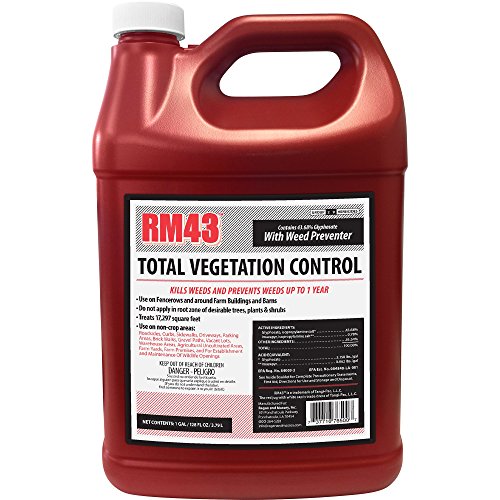
6. RM43 Concentrated Extended Control Weed Killer — Best for Bare Ground & Long-Term Control
Some areas of your property aren't meant to grow anything at all — gravel driveways, fence posts, utility areas, fence lines, storage yards. For these zones, you don't need a lawn-safe selective herbicide. You need something that clears the area completely and keeps it clear. That's exactly what RM43 Extended Control is designed for. It delivers up to one year of weed prevention after a single application, which is a significant selling point if you're tired of retreating the same areas every season.
RM43 is a concentrate that you mix with water and apply via a standard pump sprayer. Its dual-action formula combines glyphosate for immediate kill with imazapyr for soil residual activity — the imazapyr component is what gives it that long-lasting prevention effect. It's a serious product for serious weed problems, not something you want near your vegetable garden or flower beds where you intend to grow anything in the near future.
The key limitation to understand is that RM43 is not lawn-safe and not planting-safe. Use it exclusively on hardscape areas, gravel paths, around fence posts, under decks, and along property edges where bare ground is the goal. If you apply it to an area and then change your mind about planting there, you're looking at a significant waiting period before the soil residual activity dissipates. Used in the right context though, this is one of the most cost-effective long-term weed solutions available.
Pros:
- Up to 12 months of weed prevention from a single treatment
- Dual action: glyphosate kill + imazapyr soil residual
- Concentrated formula — economical coverage for large bare-ground areas
- Effective on virtually all vegetation in treated zones
Cons:
- Not suitable anywhere near lawn, garden beds, or future planting areas
- Long soil residual means you can't replant treated areas for an extended period
- Requires a separate pump sprayer
- Overkill (and potentially damaging) for typical lawn weed control
7. Roundup Dual Action 365 Weed & Grass Killer Plus 12 Month Preventer — Best All-in-One Year-Round Solution
The Roundup Dual Action 365 takes the proven Roundup glyphosate formula and adds a pre-emergent layer to prevent new weeds from germinating for up to 12 months after application. That's a meaningful combination — you're not just killing what's already there, you're blocking what's trying to grow next. For patios, walkways, gravel areas, and landscaped beds where you're done dealing with recurring weed cycles, this one-step approach is genuinely appealing.
The included Comfort Wand makes application more comfortable over extended use — it's a thoughtful ergonomic addition that matters when you're treating a large driveway or lengthy pathway edge. The formula handles a wide spectrum of common weeds: clover, dandelion, large and smooth crabgrass, poison ivy, and other broadleaf weeds and brush. Rainproof performance in 30 minutes means you don't have to obsessively watch the weather forecast before applying.
Like all Roundup products, this is non-selective — it kills everything it contacts. The 12-month prevention claim applies to treated surfaces and soil, making it unsuitable for areas you want to replant. But if you're committing to a weed-free zone for an entire year, the dual kill-and-prevent action in one product is a compelling time and money saver compared to buying a contact killer and a pre-emergent separately. In 2026, it remains one of the most complete single-product solutions for long-term weed-free hardscaping.
Pros:
- Kills existing weeds AND prevents new germination for up to 12 months
- Ergonomic Comfort Wand reduces hand fatigue on large areas
- Rainproof in 30 minutes with fast visible results
- Targets a broad spectrum including poison ivy, crabgrass, dandelion, and clover
- One-step solution replaces two separate products
Cons:
- Non-selective — not suitable near lawns, garden beds, or planting zones
- Higher price point than basic Roundup formulas
- Treated areas cannot be replanted for an extended period
What to Look For When Buying Weed Killers
Selective vs. Non-Selective
This is the most important decision you'll make before buying. Selective herbicides target specific plant types — typically broadleaf weeds — without harming surrounding turfgrass. The Scotts Turf Builder Weed and Feed is a good example: it kills dandelions and clover while leaving your lawn intact. Non-selective herbicides like glyphosate-based formulas kill virtually every plant they contact. Use non-selective products on driveways, walkways, gravel, and bare-ground areas. Use selective products when your lawn or desirable plants are nearby.
- Selective — safe for lawn use, targets broadleaf weeds or specific grass types
- Non-selective — kills everything, best for hardscape and bare ground
- When in doubt, check the product label — it will list what is and isn't affected
Contact vs. Systemic Action
Contact herbicides kill plant tissue on impact — fast and visible, but they may not reach the root. Systemic herbicides are absorbed through the leaves and travel through the plant's vascular system to kill the roots. For deep-rooted perennials or woody brush, systemic action is critical because surface kill alone often results in regrowth within weeks. If you're treating annual weeds or very young plants, contact action may be sufficient. For anything established, go systemic.
Pre-Emergent vs. Post-Emergent
Post-emergent herbicides kill weeds that are already growing — this is most products on this list. Pre-emergent herbicides create a chemical barrier in the soil that prevents seeds from germinating. The Roundup Dual Action 365 combines both in a single product. If you're setting up a long-term weed-free zone on a driveway or patio, a pre-emergent component adds real value by breaking the annual weed cycle before it starts. For active infestations, you need a post-emergent to deal with what's already there.
- Post-emergent — kills existing weeds, immediate results
- Pre-emergent — prevents germination, best for prevention and maintenance
- Many of the best long-term solutions combine both modes of action
Application Method and Coverage
Ready-to-use products with integrated sprayers offer the most convenience for occasional spot treatments, but they cost more per ounce. Concentrates are dramatically more economical for large areas and give you flexibility in dilution ratios, but you need your own pump sprayer. Granular products like the Scotts Weed and Feed require a broadcast spreader and specific lawn conditions for activation. Think about your application area size, how often you'll be treating, and what equipment you already own before choosing a format. For most homeowners, having both a ready-to-use formula for spot work and a concentrate for large-area coverage covers all situations effectively.
Common Questions
How long after applying weed killer can I let my pets back in the yard?
It depends on the formula. Most glyphosate-based products are considered safe for pets once the treated area has fully dried, which typically takes 1–2 hours under normal conditions. Natural formulas made with vinegar and salt, like Green Gobbler, are generally safer more quickly. Always read the specific product label for re-entry intervals and avoid letting pets in treated areas until the product is dry and any visible residue has dissipated. When in doubt, wait until after the next rain to be safe.
Will weed killer affect my soil long-term?
Standard glyphosate-based herbicides break down relatively quickly in soil through microbial activity and typically don't leave long-term residues under normal application rates. Products with soil residual activity — like RM43 (which contains imazapyr) or Roundup Dual Action 365 — are designed to persist in the soil for months to prevent germination, so you should not plant in those areas for an extended period after treatment. Always check the product label for specific replanting intervals. Salt-based natural products can affect soil structure and salinity with repeated heavy applications.
What's the best weed killer for a lawn with kids?
If you have young children who play on your lawn frequently, you have two main options. First, use a natural formula like Green Gobbler in high-traffic areas — made from vinegar and salt, it poses minimal risk once dry. Second, if you need chemical control, apply any product when your kids won't be using the yard for the rest of that day, allow it to fully dry, and consider rinsing hardscape areas with water before resuming normal use. For lawn-specific weed control, selective herbicides like Scotts Weed and Feed are applied to the whole lawn and dry safely into the turf without concentrated spray residue.
Can I use weed killer near my vegetable garden?
Extreme caution is required. Non-selective herbicides like glyphosate can kill vegetable plants on contact, and soil-residual products can prevent vegetables from establishing. If you need to treat weeds near a vegetable garden, use a targeted application with a shield or cardboard barrier to prevent drift onto your plants. Natural options like vinegar-based sprays are a safer spot-treatment choice near edibles, but keep in mind they can still kill vegetable plants if they contact the leaves. Avoid any product with a soil pre-emergent component anywhere near an active vegetable bed.
How do I kill weeds without killing my grass?
The key is using a selective herbicide formulated for lawn use. Products like Scotts Turf Builder Weed and Feed 3 target broadleaf weeds like dandelion and clover while leaving turfgrass unharmed. For grassy weed problems like crabgrass, look for a crabgrass preventer with pre-emergent action applied in early spring before soil temperatures warm up enough for germination. Never use non-selective glyphosate products on your lawn unless you're targeting a very specific spot and applying with extreme precision — one careless pass can leave dead patches that take months to recover.
Is it better to spray weeds in the morning or evening?
Morning application is generally considered optimal — plants are actively absorbing moisture and nutrients early in the day, which can improve herbicide uptake. Midday application during high heat can cause rapid evaporation, reducing effectiveness. Evening is acceptable but morning is preferred. More importantly, avoid applying on windy days (risk of drift), during rain or before expected rain (washoff before rainproofing activates), and during drought stress when plants aren't actively growing — stressed plants don't absorb herbicides as effectively, which reduces your results regardless of when you apply.
Buy on Walmart
- Roundup Weed and Grass Killer₄ with Pump 'N Go 2 Sprayer, Us — Walmart Link
- Compare-N-Save 75324 Herbicide, 1-gallon, white — Walmart Link
- Green Gobbler Natural Total Control Weed & Grass Killer | Ma — Walmart Link
- BioAdvanced Brush Killer Plus, Weed Killer Concentrate, 32 o — Walmart Link
- Scotts Turf Builder Weed and Feed 3, 15,000 sq. ft. — Walmart Link
- RM43 Concentrated Extended Control Weed Killer — Walmart Link
- Roundup Dual Action 365 Weed & Grass Killer Plus 12 Month Pr — Walmart Link
Buy on eBay
- Roundup Weed and Grass Killer₄ with Pump 'N Go 2 Sprayer, Us — eBay Link
- Compare-N-Save 75324 Herbicide, 1-gallon, white — eBay Link
- Green Gobbler Natural Total Control Weed & Grass Killer | Ma — eBay Link
- BioAdvanced Brush Killer Plus, Weed Killer Concentrate, 32 o — eBay Link
- Scotts Turf Builder Weed and Feed 3, 15,000 sq. ft. — eBay Link
- RM43 Concentrated Extended Control Weed Killer — eBay Link
- Roundup Dual Action 365 Weed & Grass Killer Plus 12 Month Pr — eBay Link
Key Takeaways
- For lawn use, always choose a selective herbicide — non-selective glyphosate formulas kill turfgrass along with weeds and have no place near an active lawn.
- The Roundup Pump 'N Go is the most convenient ready-to-use option for garden beds and occasional spot treatments, while Compare-N-Save delivers the same active ingredient at a fraction of the cost for large coverage areas.
- RM43 and Roundup Dual Action 365 are the strongest long-term prevention picks for hardscape zones where you want up to 12 months of weed-free results with minimal retreatment.
- If you have pets or children using the treated area regularly, Green Gobbler's vinegar-and-salt formula is the most practical natural alternative that still delivers real kill results on a wide range of common weeds.


About Lee Safin
Lee Safin was born near Sacramento, California on a prune growing farm. His parents were immigrants from Russia who had fled the Bolshevik Revolution. They were determined to give their children a better life than they had known. Education was the key for Lee and his siblings, so they could make their own way in the world. Lee attended five universities, where he studied plant sciences and soil technologies. He also has many years of experience in the U.S. Department of Agriculture as a commercial fertilizer formulator.
Get FREE Gardening Gifts now. Or latest free toolsets from our best collections.
Disable Ad block to get all the secrets. Once done, hit any button below