Roughly 70 percent of homeowners who broadcast grass seed by hand end up with visibly patchy lawns — a result that almost always comes down to uneven distribution. Using lawn spreader for grass seed eliminates that problem entirely by delivering a measured, consistent amount of seed across every square foot of your yard. Whether you're overseeding a tired lawn or establishing turf on bare ground, the right spreader turns a frustrating guessing game into a repeatable process. Start with the fundamentals and explore more gardening tips to build a complete lawn care routine.
The short answer is yes — any walk-behind broadcast spreader, drop spreader, or handheld crank model can handle grass seed. The type you choose and the settings you dial in matter more than most people realize, though. Use the wrong model in the wrong conditions and you'll still end up with gaps and clumps, just with more effort spent getting there.
This guide walks you through exactly how each spreader type works with seed, what you can expect to spend, when a spreader is the right call and when it isn't, which mistakes consistently waste the most seed, and the practical habits that separate a lush, even lawn from one that needs redoing next season.
Contents
Using Lawn Spreader for Grass Seed: How Each Type Works
A lawn spreader controls two things: how much seed flows out and where it lands. As you walk at a steady pace, a gate or spinning mechanism releases seed at a consistent rate, covering a defined width with each pass. The result is a seedbed where every square foot receives roughly the same amount of material — something your hands simply cannot replicate over an entire yard.
The critical difference from hand-broadcasting is repeatability. Your throwing motion changes constantly — arm height, release angle, walking speed — so the distribution is always uneven. A calibrated spreader holds those variables steady, row after row, from the first pass to the last.
Broadcast Spreaders
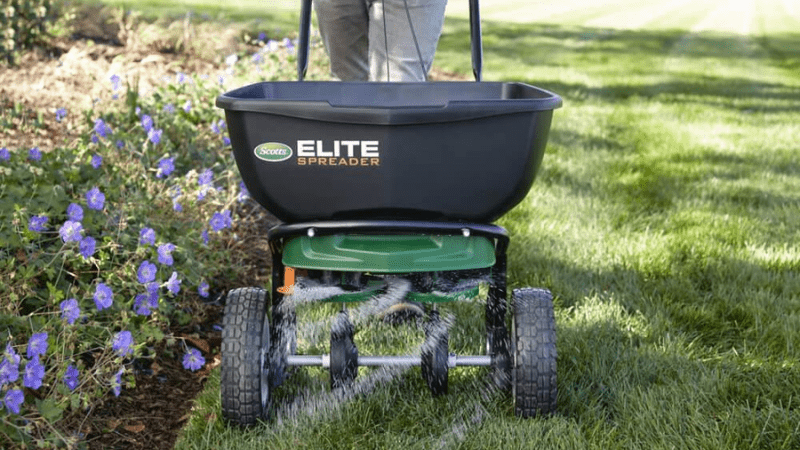
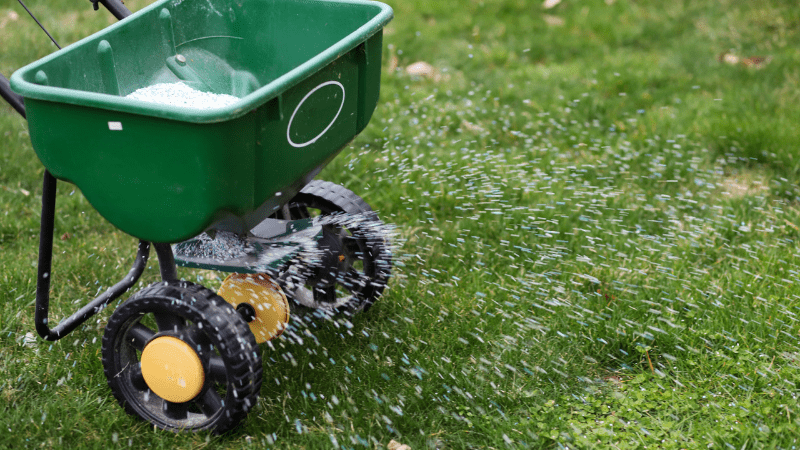
Broadcast spreaders — sometimes called rotary spreaders — use a spinning disc driven by the wheel as you walk. Seed drops from the hopper onto the disc and flings outward in a fan pattern, covering a swath roughly 8 to 12 feet wide per pass. That width makes them fast. A typical backyard of 5,000 square feet takes only a few minutes to cover once you're moving at a steady pace.
The tradeoff is directional accuracy. Seed fans outward in an arc, so some will land on driveways, garden borders, or mulched beds if you aren't careful near the edges. Wind pushes lighter seed varieties off course more easily than heavier ones. For wide-open turf with clean borders, broadcast models are the fastest and most efficient choice. Near delicate plantings or hardscaping, switch to a drop spreader for those perimeter passes.
Drop Spreaders
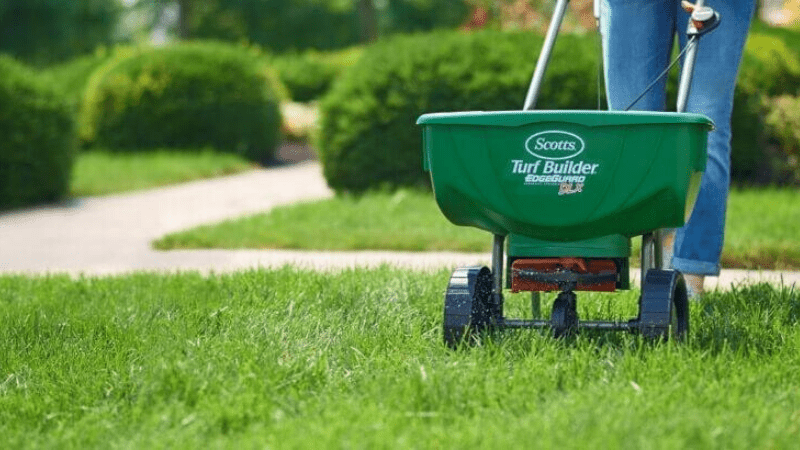
Drop spreaders release seed straight down through a row of openings along the bottom of the hopper. Coverage width is narrow — typically 18 to 24 inches — but seed lands exactly where you direct the spreader. That precision matters enormously along flower beds, fencing, pathways, or any area where stray seed would cause problems.
According to Wikipedia's overview of broadcast spreaders, drop models are the preferred tool when application accuracy outweighs the need for speed — particularly on small to medium lawns or when establishing a new lawn where an even seedbed is critical from the start.
The practical downside is time. Covering a large yard with a drop spreader requires significantly more passes. Most gardeners find the smartest strategy is a broadcast spreader for the open interior and a drop spreader for the perimeter and tight areas.
Spreader Types and What They'll Cost You
Spreaders range from basic handheld tools that cost less than a coffee shop run to premium walk-behind models built to last decades. Understanding what each price point actually delivers helps you avoid both overspending and buying something too limited for your lawn's size.
Entry-Level Options
Handheld crank spreaders sit at the bottom of the price range and are genuinely useful for small jobs. You hold them in one hand, crank a handle, and seed broadcasts out in a modest arc of 2 to 4 feet. They're the right tool for touching up bare spots, seeding along a narrow strip, or handling any area under 500 square feet. Anything larger and the physical effort — combined with inconsistent crank speed — starts to show up as uneven coverage.
For more on how handheld models perform with lawn products beyond just seed, our post on using a hand spreader for weed and feed covers the key limitations and best-use cases — most of those points transfer directly to grass seed applications.
Mid-Range and Premium Models
Walk-behind broadcast and drop spreaders are where most homeowners should spend their money. A solid mid-range model in the $50 to $120 range comes with a rust-resistant hopper, an adjustable flow gate with marked settings, a spread width of 8 to 10 feet, and a hopper large enough to handle 5,000 square feet in one fill. You won't need to stop and refill mid-lawn.
Premium models add edge-guard settings that block seed from the outward half of the throw — useful near beds and borders without switching tools — along with enclosed gearboxes that resist grit and corrosion, ergonomic padded handles, and stainless hardware throughout. If you're seeding or fertilizing the same lawn every season, a premium model pays for itself in durability alone. Our guide to the best lawn spreaders walks through top-rated options across every price bracket if you want side-by-side comparisons.
| Spreader Type | Typical Cost | Coverage Width | Best For | Precision |
|---|---|---|---|---|
| Handheld / Crank | $10–$30 | 2–4 ft | Small patches, touch-ups | Low–Medium |
| Broadcast Walk-Behind | $40–$150 | 8–12 ft | Large open lawns | Medium |
| Drop Walk-Behind | $50–$180 | 18–24 in | Borders, precision areas | High |
| Tow-Behind (ATV/Mower) | $80–$300 | 10–15 ft | Large properties, acreage | Medium |
The Right Time to Spread — and When to Put the Spreader Away
The spreader is a tool, not a universal solution. Knowing when conditions favor it — and when they work against you — keeps you from wasting product and effort.
Best Conditions for Spreading Seed
Reach for a spreader any time you're covering more than 500 square feet. Below that threshold, the setup and cleanup time starts to rival just hand-broadcasting. Above it, the spreader's consistency advantage compounds with every additional row you walk.
Calm weather is non-negotiable for broadcast models. Even a modest wind of 8 to 10 miles per hour pushes lighter grass seed several feet off course, creating invisible gaps that only become visible as bare strips weeks later. Early mornings are ideal — wind speeds are typically lower, temperatures are cooler, and the soil retains some moisture from overnight dew. Seed-to-soil contact is what drives germination, so any condition that puts seed directly on moist soil surface is a condition worth working with.
Mow your lawn short — around 1.5 to 2 inches — before you seed. Tall grass blades intercept falling seed and hold it off the soil surface, where it either dries out or blows away before it ever has a chance to germinate.
When Hand-Seeding Makes More Sense
Skip the spreader for individual bare spots smaller than a square foot or two. Rolling equipment over a tiny patch can compact the soil and disturb surrounding grass roots. A pinch of seed pressed gently into the soil and covered with a thin layer of compost works faster and causes less disruption.
Also skip it on steep slopes. Seed rolls off inclines before it reaches the soil, and pushing a heavy walk-behind uphill is both awkward and tiring. On gradients steeper than roughly 15 degrees, consider hydroseeding or hand-sowing with an erosion mat to keep seed in place while it germinates.
Pro tip: Always close the spreader's hopper gate before you stop walking — pausing mid-row with the gate open dumps a concentrated pile of seed in one spot that creates a thick, overcrowded clump instead of even turf.
Mistakes That Waste Seed and Set You Back
Most seeding failures come down to a handful of predictable errors. Knowing them before you start is the cheapest form of insurance available.
Wrong Dial Settings
The wrong dial setting is the single most common mistake homeowners make when using a spreader for grass seed. Set it too high and you dump seed so densely that seedlings compete with each other for water, nutrients, and light — a condition that leads to weak, thin turf as the season progresses. Set it too low and you get sparse coverage that weeds colonize before your grass can establish a foothold.
Seed bags list recommended settings for specific spreader models, but those calibrations don't transfer between brands. A setting of "5" on a Scotts rotary spreader delivers a completely different flow rate than "5" on a generic hardware store model. The only way to know your spreader is accurate is to calibrate it yourself — a ten-minute test that protects an entire bag of seed.
Overlapping and Missing Strips
Broadcast spreaders require a consistent 1.5 to 2 foot overlap between passes to avoid visible stripes from underlapping. But too much overlap — walking your next row too close to the last — doubles the seed rate in that strip. Those zones germinate thick, crowd themselves out, and ultimately look no better than a hand-scattered patch.
Walk in straight, parallel rows and fix your eyes on a point at the far end of your yard to keep your line true. Many experienced gardeners drop lawn marker flags every few rows on large properties, especially the first time they use a new spreader. It feels like extra work upfront, but it eliminates the back-and-forth guessing that produces an uneven final result.
Getting the Best Results from Your Spreader
A few targeted habits consistently separate a lawn that fills in thick and even from one that needs a second round of seeding a month later. None of these are complicated — they're just easy to skip when you're eager to get started.
Calibrating Before You Start
Calibration confirms your spreader actually delivers the seed rate the dial claims. The method is simple: spread a tarp or plastic sheet over a measured 10-by-10-foot test area. Weigh a known amount of seed, load it in the hopper, set the dial to your seed bag's recommendation, and push the spreader across the test area at your normal walking pace. Collect the seed that landed on the tarp and weigh it. Compare against what the seed bag says you should apply per 100 square feet.
If your numbers are off, adjust the dial up or down and repeat. Two or three iterations is usually enough to dial in an accurate rate. This step alone accounts for the biggest difference between a spreader job that works and one that doesn't.
After You've Spread the Seed
Once you've finished spreading, run a light pass with a leaf rake to nudge seed down to the soil surface. You're not burying it — most grass seed germinates best sitting right at or barely below the surface — you're just eliminating the air gap between seed and soil that slows moisture uptake.
Water immediately after seeding with a gentle mist setting, not a full stream that pushes seed around. The goal in the first week or two is keeping the top inch of soil consistently moist. Once you see germination, gradually shift toward deeper, less frequent watering to encourage roots to chase moisture downward rather than staying shallow.
Frequently Asked Questions
Can you use any lawn spreader for grass seed?
Yes — broadcast, drop, and handheld spreaders all work for grass seed. The most important thing is matching the spreader type to your lawn size and confirming the dial setting against the seed bag's recommended rate for your specific model before you start.
What setting do I put my spreader on for grass seed?
Check the seed bag label first — manufacturers list settings for major brands like Scotts, Earthway, and Agri-Fab. As a starting point, most walk-behind broadcast models fall between settings 3 and 5 for overseeding. Always run a calibration test before seeding your full lawn, since the same number means different flow rates on different spreader brands.
Can you spread grass seed with a drop spreader?
Absolutely — and for lawns with a lot of borders, beds, or hardscaping, a drop spreader is often the better choice. It delivers seed in a narrow, precise strip directly below the hopper, so you control exactly where the seed lands. You'll make more passes to cover the same area, but the accuracy is worth it.
How many passes should you make when spreading grass seed?
For overseeding an established lawn, two passes in perpendicular directions — north-to-south first, then east-to-west — at half the recommended rate each produces the most uniform coverage. This cross-hatch method reduces visible stripes and fills gaps left by single-direction spreading.
Do you need to rake after using a lawn spreader for grass seed?
A light rake pass after spreading is highly recommended. You're not burying the seed — just closing the air gap between it and the soil surface. Good seed-to-soil contact is one of the biggest factors in germination success, and a quick raking costs almost no extra time or effort.
Calibrate your spreader, walk straight lines, keep the soil moist — do those three things and a patchy lawn becomes a problem you used to have.


About Lee Safin
Lee Safin was born near Sacramento, California on a prune growing farm. His parents were immigrants from Russia who had fled the Bolshevik Revolution. They were determined to give their children a better life than they had known. Education was the key for Lee and his siblings, so they could make their own way in the world. Lee attended five universities, where he studied plant sciences and soil technologies. He also has many years of experience in the U.S. Department of Agriculture as a commercial fertilizer formulator.
Get FREE Gardening Gifts now. Or latest free toolsets from our best collections.
Disable Ad block to get all the secrets. Once done, hit any button below