Studies show that over 70% of houseplant deaths caused by pests go undetected until the infestation has already spread to neighboring plants — and by then, a simple treatment has become a full-scale battle. Indoor plants face a unique threat: closed environments trap pests like spider mites, fungus gnats, and mealybugs without natural predators to keep them in check. If you've watched a beloved fiddle-leaf fig or pothos decline despite your best watering habits, the culprit is almost always a pest problem you couldn't see.
Choosing the right insecticide for indoor plants isn't as simple as grabbing the strongest option off the shelf. Indoor use demands products that are safe around children and pets, won't off-gas toxic fumes in a closed room, and won't damage sensitive foliage. In 2026, the market offers a solid range of options — from systemic granules that protect roots for weeks to fast-acting contact sprays and concentrated neem oils. The challenge is matching the right chemistry to the specific pest you're fighting. You can find more of our top-tested garden product picks in our gardening reviews section.
This guide covers seven of the best insecticides for indoor plants available right now. Each one has been evaluated for effectiveness, safety profile, ease of use, and value. Whether you're dealing with a sudden aphid explosion on your herbs or a long-running spider mite problem that won't quit, you'll find a clear recommendation here. If you're also struggling with whiteflies specifically, check out our detailed guide on how to get rid of whiteflies on plants — it pairs well with several products on this list.

Contents
- Top Rated Picks of 2026
- Full Product Breakdowns
- Bonide Systemic Houseplant Insect Control — Best Systemic Protection
- Natria Neem Oil Spray — Best Ready-to-Use Neem Spray
- Bonide Insecticidal Soap — Best Non-Toxic Contact Spray
- Harris Concentrated Neem Oil — Best Neem Oil Concentrate
- Garden Safe Insecticidal Soap — Best for Edible Plants
- Trifecta Crop Control — Best All-in-One Natural Formula
- Garden Safe Neem Oil Extract — Best 3-in-1 Organic Option
- How to Pick the Best Insecticide for Indoor Plants
- Questions Answered
- Final Thoughts
Top Rated Picks of 2026
- #PreviewProductRating
- Bestseller No. 1
 Rating:

- Bestseller No. 2
 Rating:
 - Bestseller No. 3
 Rating:
 - Bestseller No. 4
 Rating:
 - Bestseller No. 5
 Rating:
 - Bestseller No. 6
 Rating:
 - Bestseller No. 7
 Rating:

Full Product Breakdowns
1. Bonide Systemic Houseplant Insect Control — Best Systemic Protection
If you want protection that doesn't require weekly reapplication, the Bonide Systemic Houseplant Insect Control is the most hands-off solution on this list. These granules get mixed into your potting soil or sprinkled on top and watered in, where they're absorbed through the roots and distributed throughout the plant's vascular system. Once inside the plant, the active ingredient — imidacloprid — makes the plant tissue toxic to feeding insects. Any mealybug, aphid, scale insect, or whitefly that takes a bite dies. That protection lasts up to eight weeks per application, which is a significant advantage over contact sprays you have to reapply every week.
The systemic approach has a few important practical benefits for indoor use. Because the insecticide is inside the plant rather than on its surface, you don't inhale a spray cloud when treating a room full of houseplants. The granular format is also much easier to apply precisely in containers — no drips, no overspray on furniture. One important note: systemic insecticides like imidacloprid are known to be harmful to pollinators, so this product is best suited to purely ornamental indoor plants that won't be visited by bees. Don't use it on herbs or fruiting plants indoors.
The eight-week residual is genuinely useful when you're managing a large collection of houseplants. Apply once, water in, and the plant handles its own defense for two months. It won't eliminate insects that don't feed on plant tissue — beneficial insects, gnats that breed in soil but don't eat foliage, or crawling insects that don't pierce the plant are unaffected. For a true systemic, long-term approach to sap-feeding pests on ornamentals, this is the most reliable option available.
Pros:
- Up to 8 weeks of continuous protection per application
- No spray — low odor, no inhalation risk during application
- Works from the inside out — protection can't be washed off by watering
- Kills mealybugs, aphids, scale, and whiteflies through ingestion
Cons:
- Not safe for pollinators — avoid use on flowering plants bees visit
- Doesn't work on insects that don't feed on plant tissue (e.g., fungus gnats, crawling ants)
- Slower to act than contact sprays — takes days to fully translocate


2. Natria Neem Oil Spray — Best Ready-to-Use Neem Spray
Neem oil is one of the most effective broad-spectrum pest controls available for houseplants, and Natria's ready-to-use formula removes the measuring and mixing step entirely. You pick up the 24 oz bottle, shake it, and spray — no emulsifying, no calculating dilution ratios. The formula handles aphids, spider mites, and whiteflies with equal effectiveness, disrupting the insects' ability to feed and reproduce. Neem oil's active compound, azadirachtin, is an insect growth regulator that prevents juvenile insects from maturing, which means you're breaking the reproductive cycle rather than just killing the adults on contact.
For indoor use, the ready-to-use concentration is well-calibrated. Neem oil can burn plant foliage if applied at too high a concentration or in direct bright light, and a pre-mixed formula eliminates that risk of user error. The scent is the main trade-off — neem oil has a distinct earthy, slightly sulfurous smell that lingers in enclosed spaces for several hours after application. Apply it in a well-ventilated area or before leaving the house for a few hours. The smell dissipates completely once dry.
Natria's formula works on both indoor and outdoor plants, which makes it a versatile bottle to keep on hand. It's effective across all life stages — eggs, larvae, and adults — which is the real strength of neem-based products. A single treatment isn't always sufficient for heavy infestations; plan for two or three applications spaced five to seven days apart to break through a full pest cycle. For an already established indoor growing setup, this is a straightforward, low-toxicity spray that earns its place in any plant care kit.
Pros:
- Ready-to-use — no mixing or dilution required
- Works on eggs, larvae, and adults
- Safe for use on indoor and outdoor plants
- Disrupts insect growth cycle, not just adult kill
Cons:
- Strong neem odor — noticeable indoors for several hours
- Multiple applications needed for heavy infestations
- Can cause leaf burn if applied in intense direct light

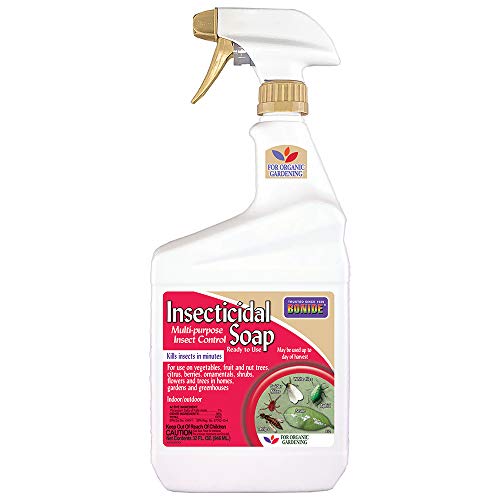
3. Bonide Insecticidal Soap — Best Non-Toxic Contact Spray
Bonide's Captain Jack's Insecticidal Super Soap is one of the most versatile contact insecticides on the market, with a pest kill list that spans adelgids, aphids, borers, caterpillars, spider mites, crickets, thrips, weevils, and more. That breadth makes it genuinely useful for indoor plant collections where you might be dealing with multiple pest types simultaneously. The mechanism is direct — potassium salts of fatty acids penetrate the insect's soft outer shell, disrupting cell membranes and causing rapid dehydration. No residual required. Death on contact.
The soap-based formula is one of the safest options for indoor application. It breaks down quickly after drying, leaves no persistent residue, and has no systemic effect on plant tissue. For households with children or pets, this is a significant practical advantage. The 32 oz ready-to-use bottle is large enough to treat a substantial number of plants without running out mid-treatment. Apply it by thoroughly coating all leaf surfaces — including the undersides, where most soft-bodied pests congregate. Leaf-chewing insects like caterpillars and worms are controlled either by direct spray contact or by ingesting treated leaf surface.
Keep in mind that contact-only insecticides require thorough coverage to be effective. Missing leaf undersides or crowded stem junctions leaves survivors who repopulate within days. For established infestations, treat every three to five days for two weeks to catch new hatchlings. This product also works on ornamentals, greenhouse plants, and a wide range of edible crops including herbs, berries, and vegetables — making it an extremely flexible tool for anyone growing a mix of food and decorative plants indoors or in a sunroom.
Pros:
- Kills a very wide range of pest species on contact
- Soap-based formula is safe around people and pets when dry
- Works on both piercing insects and leaf-chewing caterpillars
- Suitable for edible crops, ornamentals, and greenhouse plants
Cons:
- Contact-only — no residual protection after drying
- Requires thorough leaf coverage including undersides
- Multiple applications needed to break infestation cycles

4. Harris Concentrated Neem Oil — Best Neem Oil Concentrate
Harris Concentrated Neem Oil is cold-pressed and 100% pure — no fillers, no added surfactants, just raw neem oil in a 12 oz bottle. That purity matters because cold-pressing retains the highest concentration of azadirachtin, the compound responsible for neem's insecticidal, fungicidal, and miticidal properties. At full concentrate, this bottle produces substantially more mixed spray than any ready-to-use product at the same price point, making it the best value option for growers treating multiple plants or larger collections. Dilute one to two tablespoons per gallon of warm water with a few drops of dish soap to emulsify properly.
The 3-in-1 function — insecticide, fungicide, and miticide — is a genuine selling point. If you're running a grow tent or indoor garden where spider mites and powdery mildew tend to appear together (they often do in warm, slightly dry conditions), a single spray addresses both problems simultaneously. Harris labels this as cosmetic grade, meaning the oil is high-purity enough for skin use, which is a useful indicator of its safety profile for indoor environments. It's also approved for organic gardening applications.
The main trade-off with any concentrate is the mixing step. You need warm water to dissolve neem oil properly, a surfactant to keep the emulsion stable, and a pump sprayer to apply it effectively. That's more setup than a ready-to-use spray, but the cost savings over time are substantial. For anyone growing indoors with a grow light setup and dealing with recurring pest cycles, investing in a concentrate and a quality sprayer is the smarter long-term approach.
Pros:
- 100% cold-pressed concentrate — highest azadirachtin content
- Covers insects, fungal diseases, and spider mites in one product
- Excellent value per gallon of mixed spray vs. ready-to-use options
- Approved for organic gardening
Cons:
- Requires mixing with warm water and an emulsifier before use
- Strong neem odor — more intense at concentrate stage
- Less convenient for quick spot treatments than a pre-mixed spray

5. Garden Safe Brand Insecticidal Soap — Best for Edible Plants
Garden Safe's Insecticidal Soap Insect Killer earns the top spot for edible plant use because of one feature no other product on this list offers in the same way: you can apply it right up to the day of harvest. If you're growing indoor herbs, cherry tomatoes on a windowsill, or container peppers, that matters enormously. Other insecticides require waiting periods of several days to weeks between treatment and harvest. Garden Safe's soap formula breaks down rapidly on contact with plant tissue and air, leaving no toxic residue by the time you pick your produce.
The 32 oz ready-to-use spray bottle delivers a broad-spectrum contact kill through potassium salts of fatty acids — the same mechanism as the Bonide soap earlier in this list, but with certification for organic gardening and edibles specifically highlighted on the label. It works indoors, outdoors, and in greenhouses on vegetables, fruit trees, ornamentals, shrubs, and flowers. Coverage is key: spray all plant surfaces thoroughly, including the underside of leaves. Pests must be hit directly — this is a contact spray, not a systemic or residual treatment.
For indoor herb gardeners and anyone growing food plants year-round under supplemental light, this is the product to reach for first. It's a particularly smart tool to keep alongside a good set of grow bags — containers make treatment easier since you can rotate and access all sides of each plant. The spray bottle trigger is well-designed and doesn't fatigue your hand during extended treatment sessions. If you only buy one insecticide for a kitchen herb shelf or indoor vegetable setup, this is it.
Pros:
- Can be applied up to and including the day of harvest
- Certified for organic gardening
- Safe for use indoors, outdoors, and in greenhouses
- Kills on contact — fast acting
Cons:
- No residual protection — repeat applications required
- Must make direct contact with pests to be effective
- Not ideal for very large infestations where more aggressive systemic treatment is needed

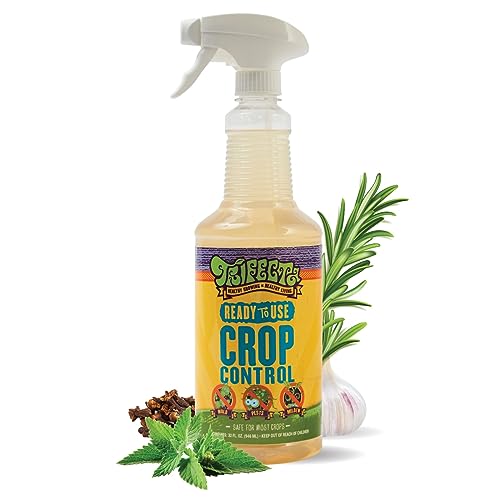
6. Trifecta Crop Control — Best All-in-One Natural Formula
Trifecta Crop Control is built on a plant-based essential oil formula that combines pesticide, fungicide, and miticide properties into one ready-to-use spray. It targets spider mites, aphids, whiteflies, fungus gnats, botrytis, powdery mildew, and other soft-bodied pests — making it the broadest-spectrum natural option on this list. The essential oil formula suffocates and dehydrates soft-bodied insects without leaving toxic chemical residues, which matters when you're growing food crops or have sensitive members of the household. The formula is biodegradable, and the label carries no EPA registration concerns for residential indoor use.
The fast-drying formula is one of the most practically useful features for indoor plant care. With many oil-based treatments, you end up with a greasy film on leaves that attracts dust and can clog stomates over time with repeated application. Trifecta dries clean without residue, which means it's safe to apply in living spaces without worrying about staining furniture or leaving a sticky film on your plant collection. The 32 oz ready-to-use size is appropriate for a moderate collection; serious growers will want to look at their larger size options for cost efficiency.
Fungus gnats are particularly difficult to eliminate because their larvae live in soil and are rarely reached by surface sprays. Trifecta's formula, when applied as a soil drench (not just a foliar spray), interrupts the larval stage in the potting mix. That dual-action approach — foliar spray for adults and soil drench for larvae — is what makes it uniquely effective for gnat infestations that have resisted simpler contact sprays. For anyone dealing with simultaneous fungal and pest problems on the same plants in 2026, this is the most complete single-product solution.
Pros:
- Combines pesticide, fungicide, and miticide in one formula
- Fast-drying — no sticky residue on leaves or surfaces
- Biodegradable, plant-based essential oil formula
- Effective against fungus gnat larvae when used as soil drench
Cons:
- Essential oil smell is noticeable — ventilate during application
- Higher price point than basic soap or neem sprays
- Requires repeat applications for heavy infestations

7. Garden Safe Neem Oil Extract Concentrate — Best 3-in-1 Organic Option
Garden Safe's Neem Oil Extract Concentrate brings together fungicide, insecticide, and miticide action in a single 10 fl oz concentrate bottle approved for organic gardening. What separates this from other neem concentrates is the documented effectiveness across all three life stages of listed insects — eggs, larvae, and adults. Most contact sprays kill adults on contact but leave eggs unaffected, which means you're back to square one after a week when the next generation hatches. Garden Safe's neem extract disrupts development at every stage, making it significantly more effective at permanently reducing pest populations.
The fungicidal properties are legitimately useful for indoor plants. Roses, flowers, fruit trees, and vegetables are all listed on the label, and common indoor fungal issues like powdery mildew and black spot fall within its control range. Use it on houseplants, ornamental trees, shrubs, and in indoor gardens. Like all neem concentrates, you'll need to mix it with warm water and an emulsifying agent (dish soap works fine) before application. The 10 oz bottle produces considerably more spray volume than it looks like it should — a little neem concentrate goes a long way.
The combination of organic certification, three-way pest control, and multi-life-stage effectiveness makes this one of the most complete pest management tools available for indoor plant enthusiasts in 2026. It works particularly well as part of a rotation strategy — use it every two to three weeks as a maintenance application alongside a contact spray for active infestations. According to the overview of neem oil on Wikipedia, azadirachtin has been used in pest management for over three decades with an excellent safety profile for mammals and beneficial insects — a track record no synthetic insecticide can match at this price point.
Pros:
- Kills insects at egg, larval, and adult stages
- Functions as fungicide, insecticide, and miticide simultaneously
- Approved for organic gardening
- Excellent cost efficiency as a concentrate
Cons:
- Requires mixing — not as quick to use as RTU sprays
- Neem odor, though it dissipates after drying
- 10 oz bottle may not be enough for very large collections without purchasing multiple bottles


How to Pick the Best Insecticide for Indoor Plants
With seven products across four distinct formulation types — systemic granules, insecticidal soaps, neem concentrates, and essential oil blends — the choice comes down to a few key factors. Work through these criteria before you buy, and you'll land on the right product the first time.
Identify Your Pest First
Different insecticides target different pest types, and picking the wrong chemistry wastes time and money. Sap-sucking insects (aphids, mealybugs, scale, whiteflies) are controlled by systemic products like the Bonide granules as well as contact sprays including insecticidal soaps and neem. Spider mites respond best to dedicated miticides — neem oil and Trifecta Crop Control both cover this. Fungus gnats require a soil drench approach, not just a foliar spray; look at Trifecta or neem drenches for gnat larvae. Caterpillars and leaf-chewing insects need a contact spray that coats the leaf surface — insecticidal soap is the right tool. If you're unsure what pest you're dealing with, check the undersides of leaves first: that's where most infestations originate and concentrate.
Systemic vs. Contact: Match Your Situation
Systemic insecticides (the Bonide granules) are absorbed into plant tissue and provide weeks of continuous protection. They're ideal for ornamental plants in stable indoor environments where you want low-maintenance pest prevention. The trade-off is that they're not safe for edible plants or flowers that pollinators visit. Contact sprays work immediately on visible pests but have no residual effect once dry. They're the right choice for active infestations where you need fast knockdown, for edible plants where chemical residues are a concern, or for spot treatment of isolated problems. Most experienced plant keepers use both: a systemic for long-term prevention on ornamentals, and a contact spray kept on hand for outbreaks.
Safety Profile for Indoor Use
Indoor use sets different standards than outdoor application. Fumes, residues, and odors that are acceptable in a garden become significant in a living room or kitchen. All seven products on this list are considered safe for indoor use when applied as directed, but there are real differences in odor intensity and drying time. Soap-based products (Bonide Insecticidal Soap, Garden Safe Insecticidal Soap) are the lowest-odor options. Neem oil products have a distinctive earthy smell that dissipates after drying — plan to ventilate for two to four hours after application. Trifecta Crop Control has an essential oil scent that most people find more pleasant than neem. If you have pets, choose soap-based or neem-based products over synthetics. If you grow edibles, stick with products explicitly labeled for harvest use.
Ready-to-Use vs. Concentrate: Value Over Time
Ready-to-use sprays are convenient and require no equipment beyond a trigger bottle. They're the right choice for small collections or occasional treatments. If you're managing more than a dozen plants or treating regularly throughout the year, concentrates like the Harris Neem Oil or Garden Safe Neem Extract deliver dramatically better cost efficiency. A 12 oz concentrate typically makes 20 to 30 gallons of spray — vastly more coverage than any 32 oz RTU bottle at a similar or lower total price. The investment in a good pump sprayer pays for itself quickly. Factor in how often you'll actually treat and how many plants you have before defaulting to RTU options out of convenience.


Questions Answered
What is the safest insecticide to use on indoor plants?
Insecticidal soaps — like the Bonide Insecticidal Soap or Garden Safe Insecticidal Soap — are the safest options for indoor use. They're based on potassium fatty acids, break down rapidly after drying, leave no toxic residue, and are approved for use on edible plants including herbs and vegetables. Neem oil products are also very safe and carry an excellent track record for mammal and pet safety. Both options are dramatically safer than synthetic chemical insecticides for enclosed indoor environments.
Can I use neem oil on all my indoor plants?
Neem oil is safe on the vast majority of houseplants, but a few plant types are more sensitive to oil-based treatments — particularly plants with waxy or fuzzy leaves, succulents, and newly propagated cuttings. Always test on a small area of the plant and wait 24 hours before full treatment. Avoid applying neem oil in strong direct sunlight or under hot grow lights, as the oil can cause leaf burn at high temperatures. Apply in the evening or early morning when temperatures are cooler.
How often should I apply insecticide to indoor plants?
It depends on the product type. Systemic granules like the Bonide Systemic provide up to eight weeks of protection per application — apply and water in, then reapply when the protection period expires. Contact sprays (insecticidal soaps, neem sprays) should be applied every five to seven days for two to three weeks during an active infestation to catch newly hatched eggs. Once the infestation is controlled, monthly preventive applications are sufficient for most houseplant collections.
Will insecticide harm my plants if I use too much?
Yes — over-application can cause phytotoxicity, which shows up as yellowing, brown spots, or leaf drop. Soap-based sprays applied at too high a concentration or to moisture-stressed plants can burn foliage. Neem oil can cause leaf burn if applied in direct intense light. Always follow label dilution instructions exactly, ensure your plants are well-watered before treating (never treat a drought-stressed plant), and apply sprays in the cooler parts of the day. When in doubt, test on a single leaf before treating the entire plant.
What's the difference between a systemic and a contact insecticide?
A contact insecticide kills pests that are directly sprayed or that touch treated surfaces — it has no effect once it dries. A systemic insecticide is absorbed into the plant's vascular system and makes plant tissue toxic to feeding insects from the inside. Systemics like the Bonide granules provide extended protection that can't be washed off, but they require the pest to feed on the plant rather than just contact it. Contact sprays act immediately on visible pests but need reapplication because they leave no lasting residue. Most pest management programs use both in rotation.
Is it safe to use insecticide on indoor plants around pets and children?
Soap-based and neem-based insecticides are generally safe around pets and children once dry. Keep children and pets out of the treated area during application and until the spray has fully dried — typically 30 to 60 minutes. Avoid systemic insecticides containing imidacloprid (like the Bonide Systemic granules) in households with dogs, as imidacloprid can be toxic to dogs if ingested in sufficient quantity. For maximum safety in pet-heavy homes, stick with insecticidal soaps, pure neem oil products, or essential oil-based formulas like Trifecta Crop Control.
Buy on Walmart
- Bonide Systemic Houseplant Insect Control, 8 oz Ready-to-Use — Walmart Link
- Natria Neem Oil Spray for Gardening - Ready-to-Use - Pest Co — Walmart Link
- Bonide Insecticidal Soap, 32 oz Ready-to-Use Spray Multi-Pur — Walmart Link
- Harris Concentrated Neem Oil 100% Cold Pressed Filtered Oil — Walmart Link
- Garden Safe Brand Insecticidal Soap Insect Killer, 32 Fluid — Walmart Link
- Trifecta Crop Control Ready to Use Maximum Strength Natural — Walmart Link
- Garden Safe Neem Oil Extract Concentrate, For Organic Garden — Walmart Link
Buy on eBay
- Bonide Systemic Houseplant Insect Control, 8 oz Ready-to-Use — eBay Link
- Natria Neem Oil Spray for Gardening - Ready-to-Use - Pest Co — eBay Link
- Bonide Insecticidal Soap, 32 oz Ready-to-Use Spray Multi-Pur — eBay Link
- Harris Concentrated Neem Oil 100% Cold Pressed Filtered Oil — eBay Link
- Garden Safe Brand Insecticidal Soap Insect Killer, 32 Fluid — eBay Link
- Trifecta Crop Control Ready to Use Maximum Strength Natural — eBay Link
- Garden Safe Neem Oil Extract Concentrate, For Organic Garden — eBay Link
Final Thoughts
The right insecticide for your indoor plants comes down to what you're growing and what you're fighting — pick the Bonide Systemic granules for long-term ornamental protection, reach for an insecticidal soap when you need safe, fast knockdown on edibles or in pet-friendly spaces, and invest in a neem concentrate if you're managing a larger collection and want maximum value with multi-pest coverage. Whatever you choose, act at the first sign of infestation — early intervention with any of these products is far more effective than trying to reverse a population that's had weeks to establish itself across your entire plant collection.


About Lee Safin
Lee Safin was born near Sacramento, California on a prune growing farm. His parents were immigrants from Russia who had fled the Bolshevik Revolution. They were determined to give their children a better life than they had known. Education was the key for Lee and his siblings, so they could make their own way in the world. Lee attended five universities, where he studied plant sciences and soil technologies. He also has many years of experience in the U.S. Department of Agriculture as a commercial fertilizer formulator.
Get FREE Gardening Gifts now. Or latest free toolsets from our best collections.
Disable Ad block to get all the secrets. Once done, hit any button below